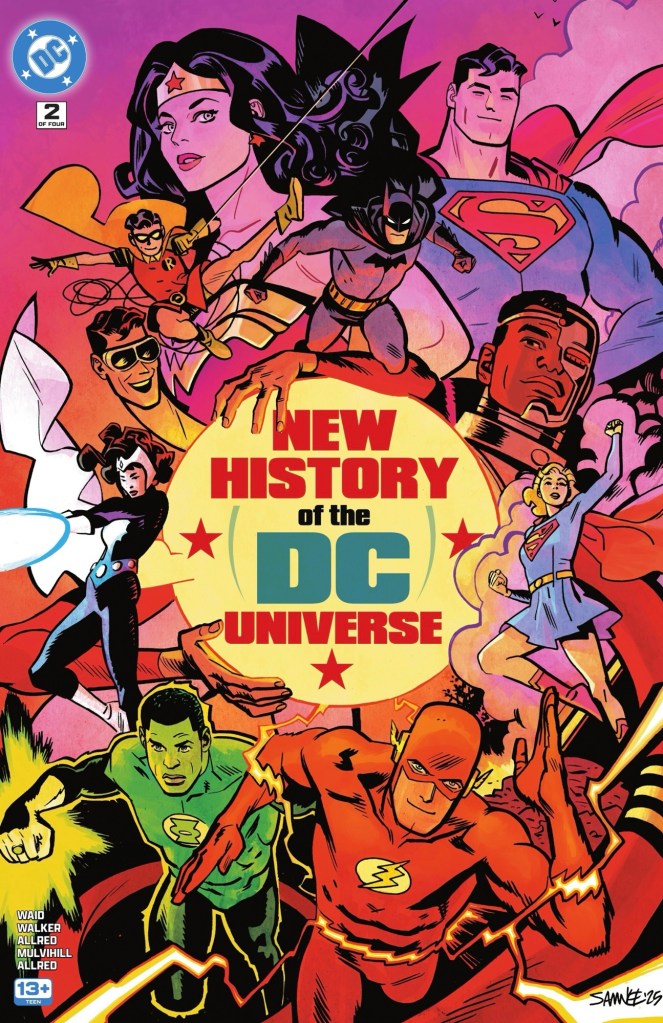
Barry Allen continues cataloguing the ages of heroes, this second of four chapters beginning with the emergence of the Silver Age stars and ending with the Crisis on Infinite Earths and the death of Supergirl and… himself.
Every page turn of the original History of the DC Universe was a thrill. Coming straight after the Crisis there was a certain suspense to proceedings – who and what had been retained when the five earths which survived the assault of the Anti-Monitor were combined into one?
The 2025 update, though, doesn’t have that built-in excitement engine; the DC Multiverse has been changing every few years, there’s no real sense that any history is settled. We’re zooming down the years but I’m not wide eyed at the idea of what I might find.
Bless writer Mark Waid, though, he’s sworn to give us at least one piece of new information each issue. Here, for example, while the New 52 versions of the heroes and origins are 99% kaput, the Geoff Johns/Jim Lee Justice League origin makes the cut, with slight alterations.

Poor old Cyborg, we learn, was in status for years, until the rise of the New Teen Titans.
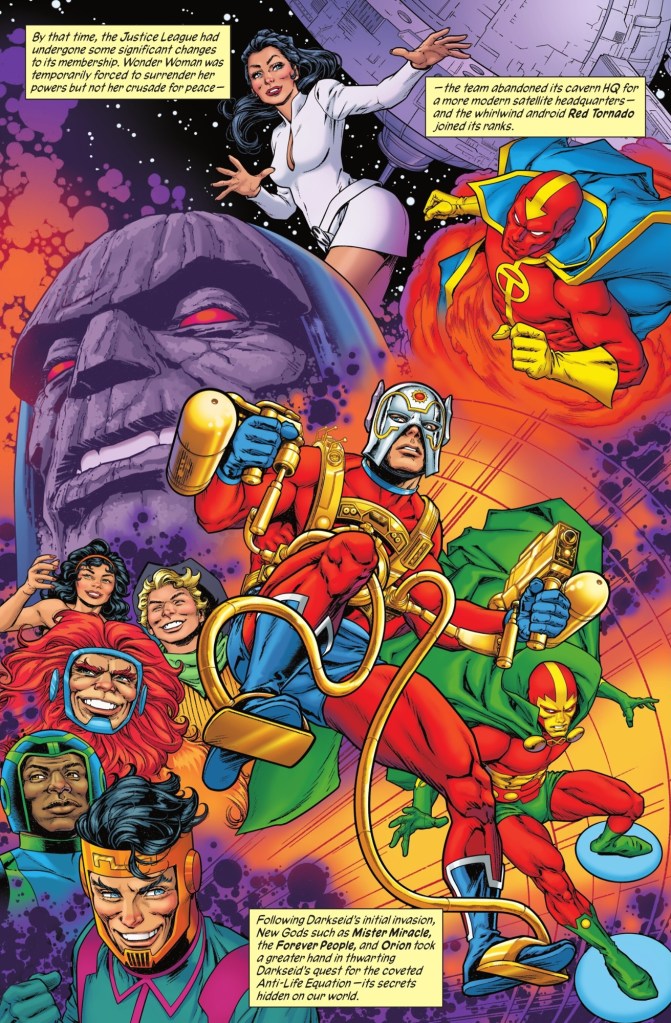
On a recent podcast Waid said, semi-jokingly, that he included the big team-up against Darkseid to keep his boss, Jim Lee, happy. He doesn’t, though, go so far as to make that the official Justice League origin, stating that came shortly after the Appellaxian invasion from Justice League of America #9’s flashback tale. Score one for the Silver Age.
Anything else? Nothing massive. Dick’s Robin wore his World’s Finest long pants for the formation of said Titans, and Aqualad Garth similarly started covering his pins shortly after his debut – there seems to be an element of teens feeling awkward about their legs.
In the absence of new information about the universe, the big story this issue is the art. Fan favourite Mike Allred handles the quirkier characters, while Brad Walker looks after the icons and their families. And the pages are fantastic. Allred’s eeriness really suits the likes of Eclipso and Dial H For Hero, but he reigns in the slight creepiness to give us the likes of Justice League Detroit, Batman and friends, and a very Christopher Reeve Superman.
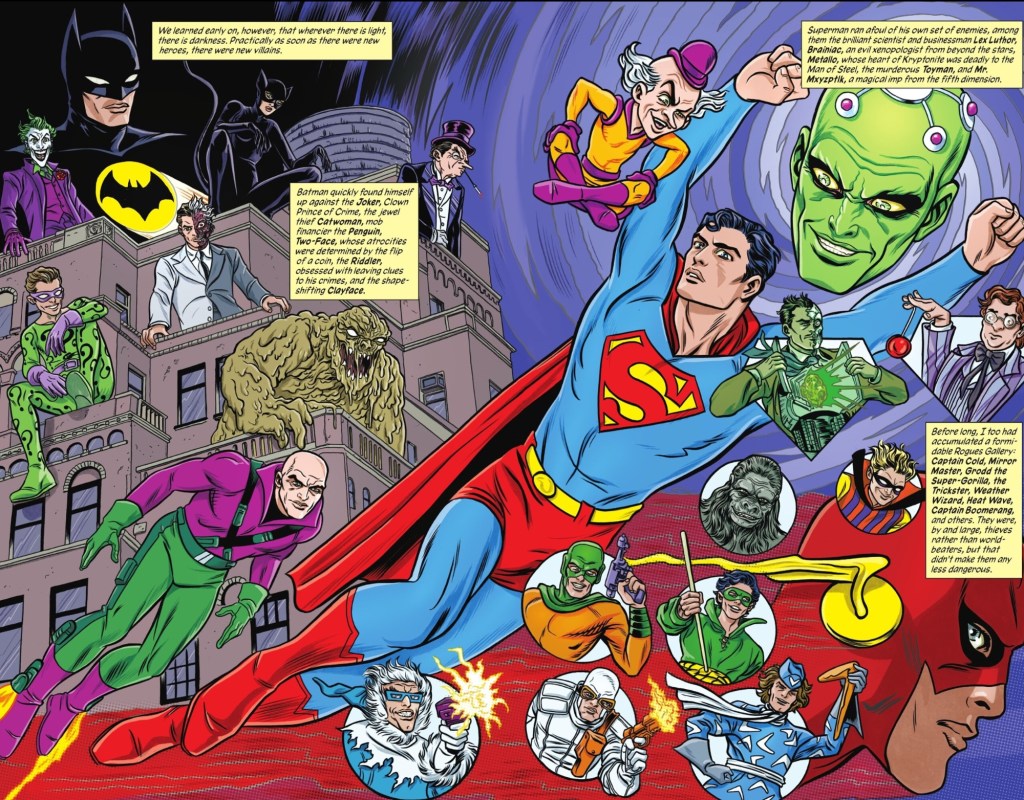
Walker, meanwhile, relishes the chance to show us what a fantastic composition man he is, with page after page of poster-worthy art.
The black mark on proceedings is the same as last issue’s – the occasional reference to The Superman Project, a government conspiracy to create superhumans which blackens the characters of the likes of Martin Stein, Doc Magnus, Simon Stagg and Niles Caulder… OK, Stagg was always a git, and Grant Morrison ruined The Chief’s rep in his classic Doom Patrol run, but do the boffins really have to be knitted together by dark manipulation?
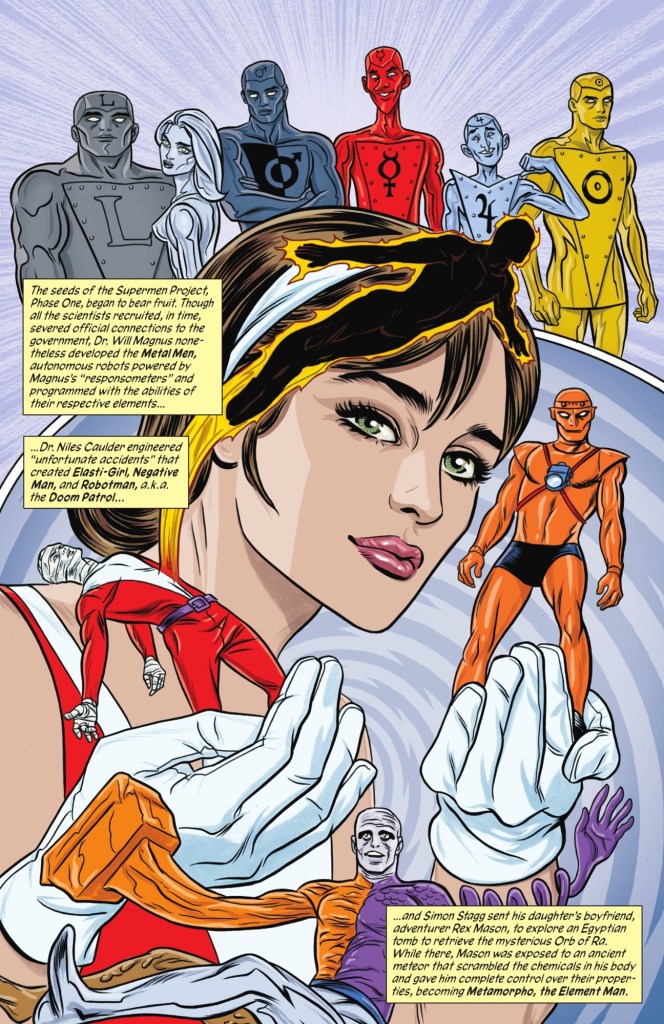
Still, I don’t know where Waid is taking the story – perhaps he was bothered by The Superman Project in Doomsday Clock as was I, and wants to soundly discredit it. (Oh dear, I said pretty much the same thing when I looked at last issue… what will I say next month? Tune in, same Mart Time, same Mart Channel.)
Trish Mulvihill colours Walker, Laura Allred colours Allred, and Todd Klein letters – talk about a dream team of craftspeople. Every aspect of this issue looks marvellous.
And that includes the continuation of the backmatter which expands on Barry’s narrative, the New History of the DC Universe Timeline by Dave Wielgosz. Designed, like the rest of the issue, by Megan Bellersen, Louis Prandi and Curtis King Jr, it’s full of fun snippets with panels extracted from comics down the decades. It’s fun, and it’s fascinating.
The cover by illustrator Chris Samnee and colour artist Giovanna Niro is a treat. Heck, the whole issue is a joy for DC trivia fans and anyone who wants to understand how the DCU came to be what it is today.
This week, anyway.

 Too Dangerous For a Girl 2
I guess I’m ok with Cyborg being part of the JLA origin since he still is part of the NTT. I’m most curious about the Crisis parts especially Supergirl dying in the Crisis
LikeLiked by 2 people
Me too. This might tell us how all of Supergirl’s pre-Crisis costumes and some of her history are back, as seen in Sophie Campbell’s current Supergirl series.
Thanks for the comments!
LikeLike
So many questions!
Wonder Woman is made of clay again?
Wonder Woman was Mod?
The Superman Project from Doomsday Clock is canon?
Terra is Deathstroke’s protege????
And where is the Legion of Super-Heroes?!
LikeLiked by 1 person
yeah, King seems to have brought back the clay origin in his current run
LikeLike
He does tend to do what he wants despite what might be canon at the time. It’s that way with characterizations certainly.
LikeLiked by 1 person
Grrr, Tom King! Although he did look nice shaved and in a suit in a photo he posted this week!
LikeLike
Apparently.
I need to see the modern version of that!
Seemingly and depressingly.
There was a lot with them in Priest’s Deathstroke run a few years back; I understood some of it, but it’s all a bit of a guddle in my head.
Issue #29, says Williamson.
LikeLike
I thought that the shoehorning in of the New 52 version of the JLA’s origin was about the most awkward thing in the book — not only did it require Waid to write in a new suspended animation stint for poor Vic Stone, but the idea of Darkseid having already invaded Earth some time before the events of Kirby’s Fourth World books doesn’t sit well with me at all. Still, I understand that this is the kind of project where I’m not going to be wild about every decision made. Overall, I appreciate the fact that Waid is cherry-picking from across all the varied iterations of the DCU to build the new continuity.
LikeLiked by 3 people
Oh, it’s a rotten idea, I bet it’s never mentioned again. Awkward is a polite way to describe it.
LikeLike
still confuses me that JSA can’t be on Earth 2, when the Crime Syndicate can be from an “alternate earth” – Mera’s from Earth? Just another nation? – Warlord in another dimension?
LikeLiked by 2 people
You’re right, the insistence on having the JSA and JLA on the same Earth makes no sense.
And I did think they’d just messed with Mera’s origins, but apparently it goes back to the Brightest Day series, which decided Xebel was an Atlantean penal colony. Ugh.
I think the Warlord bit is new, I’m sure it was the usual ‘inside Earth’ bit in Flash last year.
LikeLike
I’ve seen otherwise somewhere so I suppose it’s inconsistent. I’ve been following this one arc of Flash for some reason but may not make it to the end since it seems interminable. I did skip the Rogues Special. I pretty much hate the regular series now and still hate they Rogues are a team now. They were once credible individual threats and now they can’t come close to winning even with four other people helping.
LikeLike
It’s me. I checked my mail on a browser that gets to a site Chrome is whackadoodle on.
LikeLike
I’m definitely disappointed to see that Jerry Ordway is not working on the entire series. His artwork was one of the main reasons I bought the first issue. Still, the art on this second one looks good, so finances permitting I’ll probably pick it up, and the rest of the series.
LikeLiked by 2 people
I agree with about not liking Ordway being gone but not about Allred. I don’t hate his art but I do dislike it and have only bought one series he drew ever. It was definitely not a choice made based on the art. I wish he and the cover artist had switched jobs. 😦
LikeLiked by 1 person
Hmm, what was the series… Silver Surfer?
LikeLike
Yeah, loathed the ending but I only bought it to support Slott for defending Nick Spencer to quack jobs back at the start of the Cap is in HYDRA arc. It was such a good person thing to do when he didn’t benefit at all from doing it so far as I know. Wound up enjoying all but its ending.
LikeLike
I’d have loved Ordway on all the issues, but we are getting a bunch of great artists, such as Dan Jurgens next time. I heard Jerry on John Siuntres’ Word Balloon podcast this week saying he’s asking if he can do a mini with the Justice Guild from issue one. That would be fun!
LikeLike
Really enjoyed the 1st two issues. I’ll be very curious to see what Waid comes up with for the second pair. The similar history of Marvel that he wrote about six or so years ago was good, but I remember that once it got into the 90s and beyond it kind of went off the rails for me. Not Waid’s fault – he’s just the chronicler. But it really put a spotlight on the violence, death and never-ending events of Marvel’s more recent decades in stark contrast to the 40s, 50s, 60s, 70s and early 80s. Those 2 final issues had beautiful art but were honestly sort of cringe to read if I’m being honest because they were summarizing some pretty bad stories. That’s why these kinds of projects are a double-edged sword – they must include the good/classic work AND the bad/best forgotten. I recently read “The Other History of the DC Universe” that John Ridley wrote focusing on some of the company’s minority characters. It was very well-done/worth the time but similarly gets kind of bogged down when Ridley tries to sort out all of the absurd twists and turns and changes and drama that different writers put these characters through over the years. Again, not his fault. He’s just working with the material that’s been published. So again, curious to see how Waid tackles the 90s through today in the DCU.
I do also wonder if the powers-that-be ever discussed a history that actually was a literal publishing history, reflecting in the first issue or two the fact the DCU did not have one “prime” Earth with all its heroes on it until after the original Crisis, then all the earths were merged and history changed to what we have today. I say this because I do strongly feel that for the last few years the unofficial motto at DC has been “it all happened.” If I recall that was kind of the point of Scott Snyder’s “Death Metal,” which I really enjoyed. Key characters from that event – Perpetua, the Monitor and Anti-Monitor and World-Forger – all REMEMBER how things used to be, and the modern Wonder Woman met her original Golden Age incarnation. But maybe that would just be too-complicated/confusing and too “meta.” It likely would require more than just 4 issues. But the problem is without acknowledging that prior actual publishing history the original Crisis really does get watered down. It basically just becomes “the Anti-Monitor attacks a bunch of vague parallel earths” and so the stakes just feel that much less than they were.
-Brian
LikeLiked by 1 person
I’ve still not read the Marvel history Waid did, I had a look at Marvel but I think I’ll need a very long afternoon to get to it. You may remember I was pretty positive about the Other History.
DC have been pretty open about their ‘everything happened’ attitude without really laying out how that could be the case. I think it’s that if a writer wants to mention something that’s been forgotten for years in an issue, it’s canon… at least for that month.
I think your Meta History of the DC Universe would be a real trip.
LikeLike
I haven’t finished with all the backmatter yet, but I’m still enjoying this series. I think the next issue — incorporating the changes and then backtracks of the 80s through the 2000s — will be the most interesting of the bunch.
I wonder if we’ll see Hitman? I guess if Bloodlines is mentioned, he’ll be mentioned alongside it.
It’ll be neat to see Young Justice again, as well.
LikeLiked by 1 person
I’m sure we’ll see Hitman, it’s getting an Omnibus so FaceTime in a comic makes sense.
LikeLike
So many good bits in the 1st 2 issues but when will we get the whole story for things like how Hippolyta joined the JSA? WHat happened to the JSA or Justice Guild(would love Jerry on that series) More with Infinity Inc! Can you tell I love the old Earth 2 stuff? And why can’t they be on their own earth now that the multiverse has returned?
LikeLiked by 1 person
That final question is the killer one. Why, WHY?
Would Hippolyte’s John Byrne JSA joining from Wonder Woman no longer work? I’ve certainly lost track.
(And if you’re I’m Scotland, I hope the storm has passed you by… it’s not bad here in East Lothian.)
LikeLiked by 1 person
I was wondering if Byrne”s explanation is canon still as well(and since Hippolyta is a JSAer, I wish Fury were still her child but I get it
and not scottish… just my first name 🙂
LikeLiked by 1 person
I think mine is Roman!
LikeLike