
It’s April 2025 and comics podcasters and bloggers around the world are celebrating the 85th anniversary of the Justice Society of America. Go back 25 years, though, and comics were celebrating the arrival of a new century. The JSA series which made the team a hit with a whole new audience had just begun – it would run to 87 issues – and was set in the present day.
DC 2000, though, was a different matter altogether, being what we used to call a micro-series. It was a pair of 64pp Prestige Format comics forming a done-in-one tale of the JSA and their spiritual successors, the Justice League of America. And while Superman, Aquaman and friends get a good showing, for me this is the Justice Society’s story.
We begin, though, with a young boy on June 30 1941, playing with his toys. Rather violently.
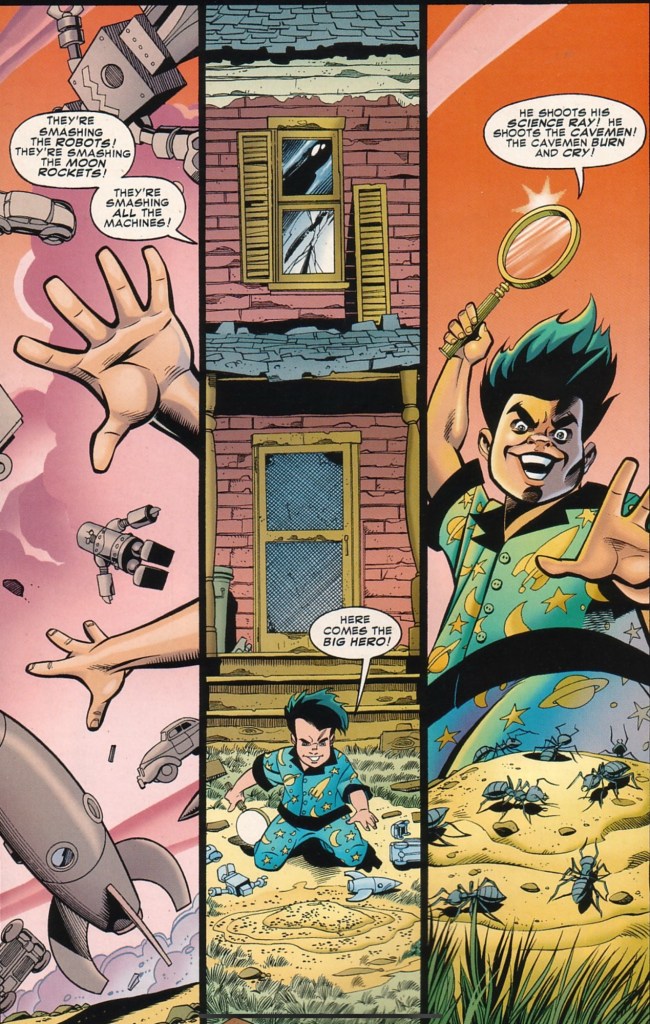
Fast forward to June 30 2000 and the kid is revealed to be the Justice League’s longtime foe TO Morrow. And he hasn’t got any kinder to living things.

The original Flash, Jay Garrick, recalls an encounter with Fly Flynn and Spider Slick, two smalltime villains out to make a name for themselves… on June 30 1941.

Where did they get such strangely futuristic weapons?
From the same man who visited Seeley, a tinkerer who wants Dr Charles McNider to help him sell an advanced artificial heart – TO Morrow.
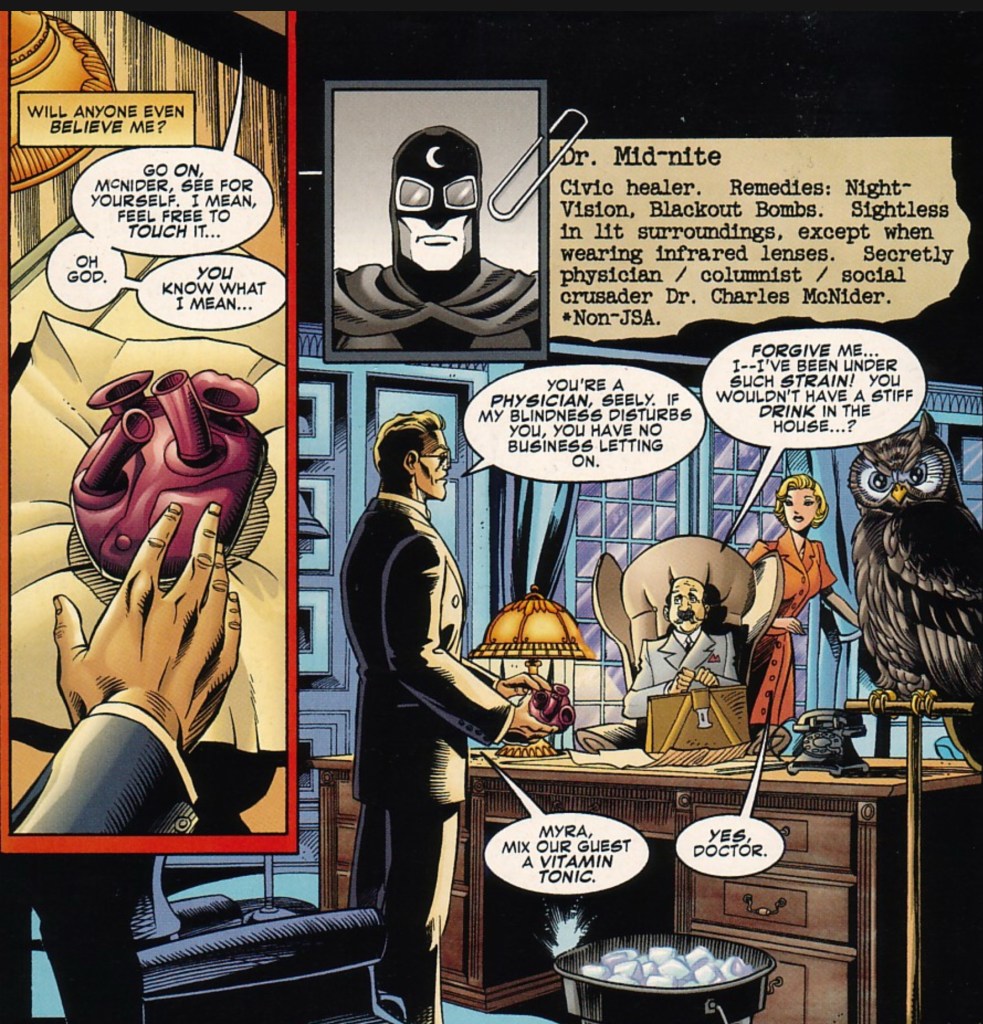
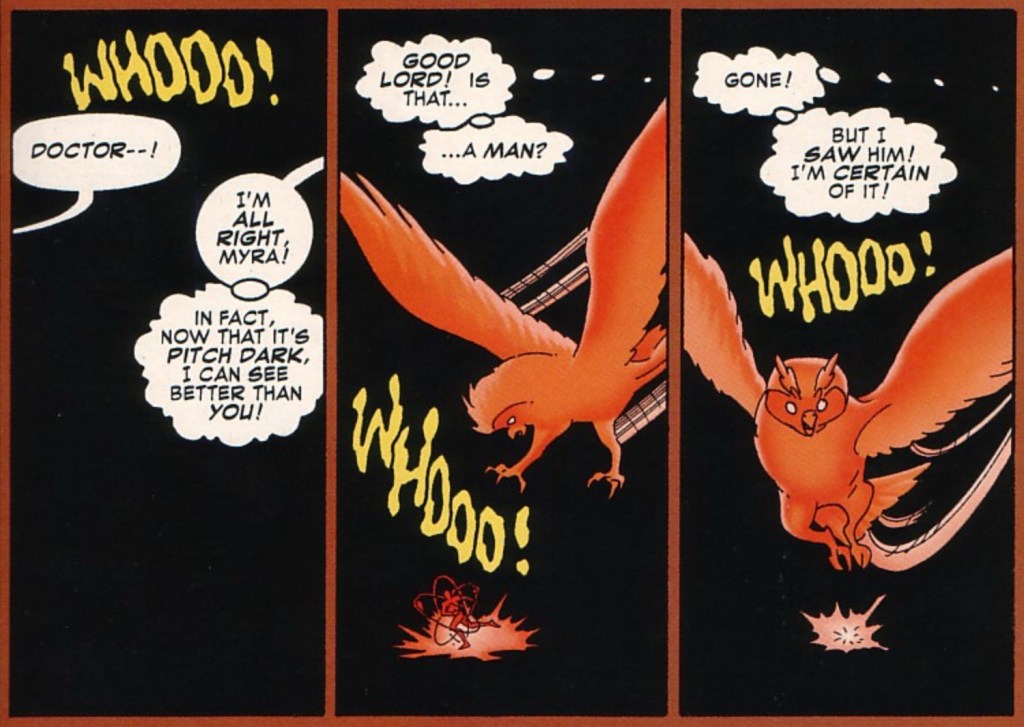
Suddenly, the artificial organ starts shrinking, the lights go out – thanks to MacNider’s owl pal – and our hero can employ his night vision.
Meanwhile, on a US military base, fellow JSA members Atom, Hawkman, Hawkgirl and Green Lantern, having fought off an advanced helicopter wielding a death ray, come across something even stranger to their eyes.

The heroes we know as the Justice League, strangers to the JSA, have come to reclaim the future devices with which Morrow is seeding the past, hoping the future changes to his advantage. Kyle Rayner befuddles the Golden Agers with his green creations – so much more intense than Alan Scott’s – long enough for the JLA to get away with the copter. While the Hawks and Green Lantern are in the skies, Atom and another team member, the Spectre, follow a lead as to the origins of the future tech to Connecticut, where a stranger makes them an offer.

Before they can answer, the man we know as Thomas Oscar Morrow teleports away and even the supernaturally powered Spectre can’t trace him – the adult villain doesn’t technically exist. The duo repair to a hastily convened JSA meeting, grabbing a strange machine Morrow has leave behind.
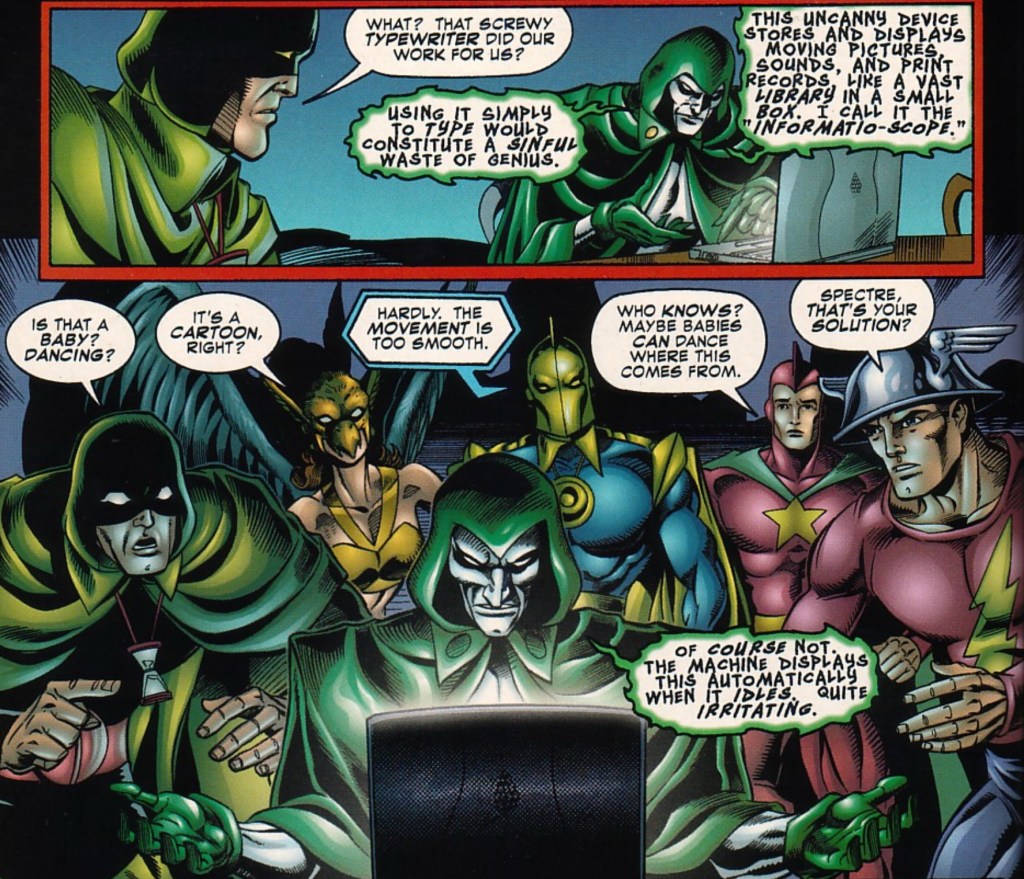
The Informatio-Scope, I love it!
I’ve taken you through some of the first issue but won’t spoil the rest, because DC 2,000 is a fabulous time for any JSA fan and it’s worth reading in full. The bad news is that it’s not, at time of writing, on the DC Infinite app. I have written to the app team to ask that the two issues be added, and I’m told the request has been passed on, so fingers crossed. Meanwhile, you can find them cheap at eBay, they’re likely in back issue boxes and, well, you can can read them for free online… it’s not like anyone is giving you a chance to buy them, so why not?
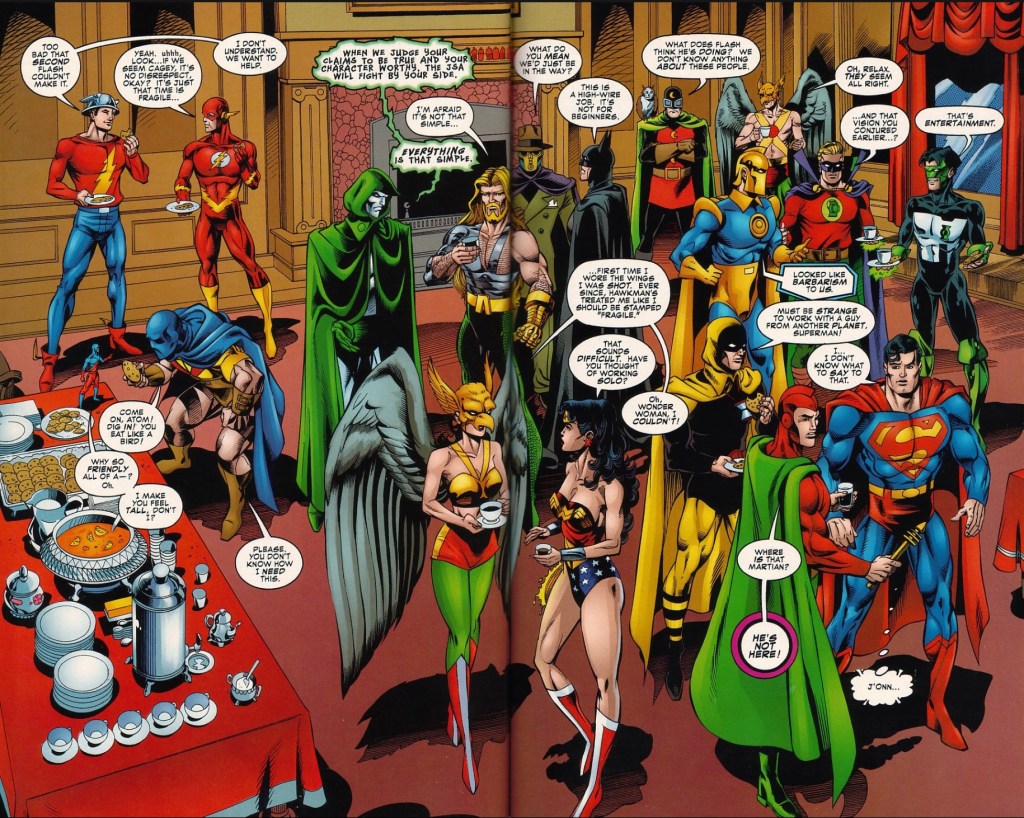
Again, while DC 2,000 is a JLA/JSA team-up – the traditional socialising spread is a delight – it’s really a Justice Society story in which the Justice League enjoy an extended cameo. Writer Tom Peyer, who was writing the fantastic android Hourman book at the time, does a marvelous job of showcasing comics’ original super team. This is the JSA at their physical peak, around the time the United States entered the Second World War. Unfortunately, being so young they’ve not known gelled yet as a team, as leader Jay finds…

The League had journeyed to 1941 to confiscate the items they believed the past wasn’t ready for, to preserve their future. But the Spectre, reading the absent Leaguers’ lingering auras, isn’t convinced the past of the heroes of the year 2000 should be allowed to occur.
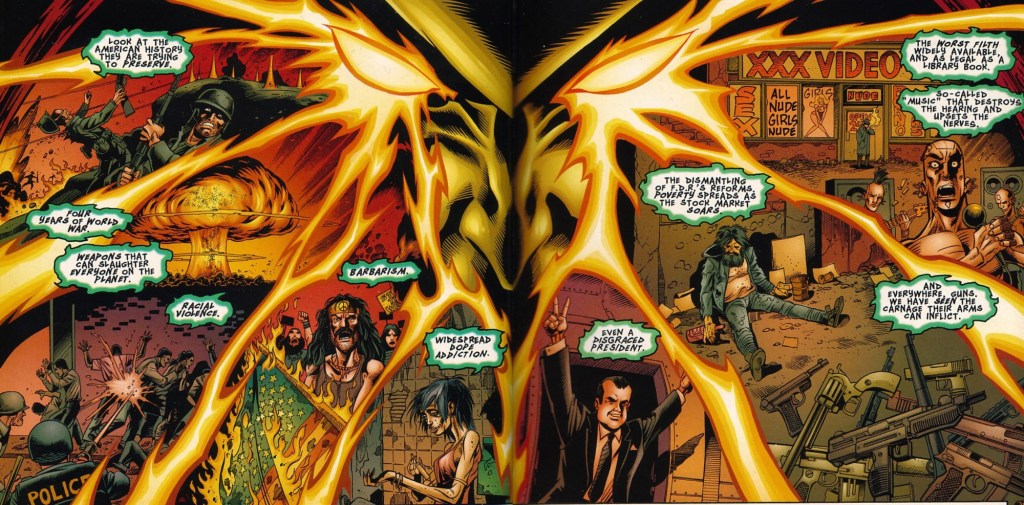
Hubris wins the day, leading to the grim version of the year 2000 seen at the beginning of the issue.
Oh heck, I wasn’t going to go further into the story… forgive me, I’m just so keen to share the goodness of a comic that should be considered a classic. Peyer’s plot is a model of stylish precision, with strong characterisation and bursts of humour to allay the occasionally dark drama.

And it’s all beautifully brought to life by penciller Val Semeiks, inker Prentis Rollins and colourist John Kalisz.
Semeiks, best remembered – by me at least – for his work on the Nineties Demon series with John Wagner gives us a classically sharp JSA, a JLA nicely in line with the then-current Grant Morrison/Howard Porter series and a scrappy looking TO Morrow. There’s nothing tricksy about the layouts but the energy levels are off the scale. Rollins’ embellishment is perfect for Semeiks’ linework, while the lush colours and textures of Kalisz add depth to the world.
Kurt Hathaway’s lettering is straightforward – letterers weren’t encouraged to lay down dozens of fonts per issue back in 2000 – and effective.
As for the covers, they’re a little dull – someone apparently thought it a good idea to ape the DC One Million cover dress of a couple of years previously. And while the result is effective as a homage, the illustrations by Semeiks, Rollins and colourists Richard and Tanya Horie fail to convey a single story point, never mind the fun.
Never mind, though, DC 2,000 is a gem of a story, one I can’t imagine any fan of the Justice Society not enjoying. You’ll have to seek it out, but I bet you’ll be glad you did.
///////
Want more JSApril content? Then pop along to the event’s home page at this link for full details of all the podcast shows and blog articles – and feel free to let us know your favourite JSA stories, characters and moments.

 Too Dangerous For a Girl 2
How have I never heard of this series? Like it’s completely off my radar and I can’t imagine how I missed it when it first came out. I shall indeed dig through the back issue bins for this. Looks like it will be a fun read.
LikeLiked by 1 person
Good luck, Murray!
LikeLike
Yeah, I’ve never heard of this miniseries, either! This isn’t an April Fool’s joke, right? This actually got published? Looks like I’m going to have to try to track it down.
Anyway, good entry for JSApril. My own contribution went online yesterday. So, Thanks for cluing me in on this.
LikeLiked by 1 person
Great review — and a great choice to highlight for JSApril! This series was a blast.
It’s funny — I can see now how dull the covers are, against what they could be. But at the time, I remember thinking they were a really clever way of visually tying the story to Morrison & co’s very successful crossover! I think the covers did a great job of selling the material to the 1990s audience, but for the back-issue audience, they’re definitely on the drab side.
LikeLiked by 1 person
You’re reminding me that I must read DC One Million from beginning to end again, Rob, I seem to have the Omnibus sitting behind me at home.
LikeLike
I don’t DO jokes, Ben!
LikeLike
No, you don’t do FUNNY jokes.
I keed. I keed.
LikeLiked by 1 person
I have no memory of this, or even hearing of this. I’ll have to look it up on one of those informatio-scopes. Or maybe on a telegraph set.
Ranger Gord.
LikeLiked by 1 person
Feel free to report back, Ranger Gord!
LikeLike