
It’s 1936 and Army engineer Alan Scott is part of a project to find and capture a legendary energy source.

It’s 1941 and FBI chief J Edgar Hoover is blackmailing mystery man the Green Lantern to help put new super team the Justice Society of America in the limelight.
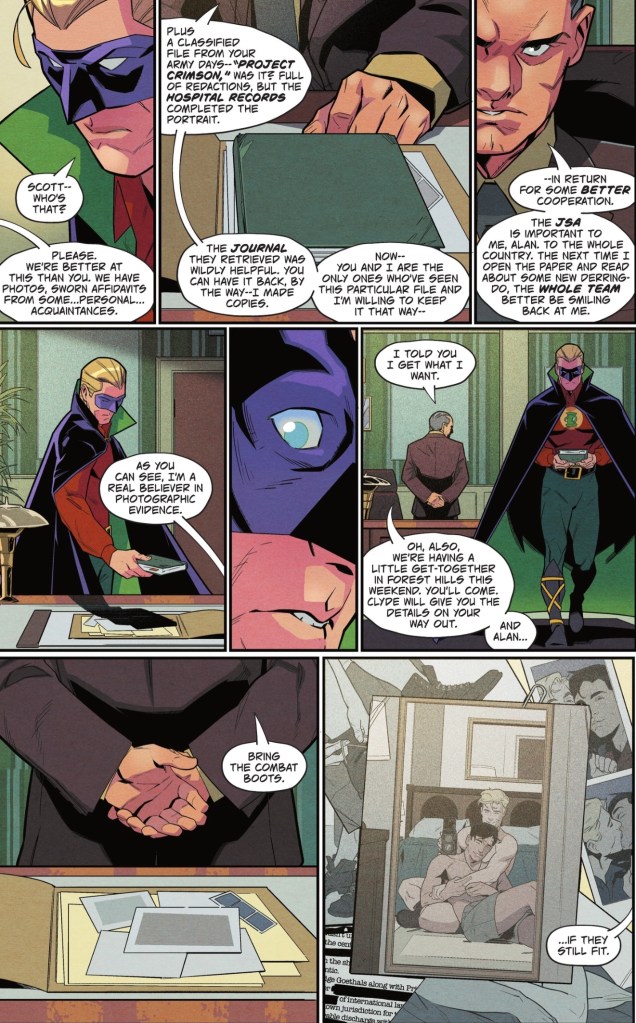
If you’re a regular reader of this blog you’ll know I’m not the biggest fan of non-linear storytelling. For the most part, there’s no problem with this debut issue, which reframes the original Green Lantern as a closeted gay man. It’s clear when we’re in the Thirties, as Alan and his secret lover Johnny Ladd head the Crimson Flame project. It’s clear when we’re in the Forties as the hypocritical scumbag Hoover confronts the Green Lantern with evidence of his supposed deviancy, then Alan confides in his pal Derby – aka Doiby – Dickles.
Where things get confusing is when TV writer Tim Sheridan starts jumping back and forth between the two parts of Alan’s life on the same page in the comic equivalent of smash cuts. The exceptionally talented team of illustrator Cian Tormey and colourist Matt Herms make it obvious that we’re in one place or the other – heck, it’s Alan in one scene, the Green Lantern in the other, and the older scenes have a Benday dot effect – but I lose the story. It’s confusing. And when the final page turns out to be a shock splash apparently set between the events of the Thirties and the Forties, I shrugged.
Said events seem to be setting up a revamp of Alan’s original comic book origin. That involved a lamp made from a mysterious meteor, a piece of which young Alan fashioned into a ring on realising its power in the aftermath of a sabotaged train killing its passengers and a colleague. Here Alan loses most of his military buddies when the Crimson Flame proves sentient, and not at all happy to be disturbed. I was wondering if it’s replacing the Green Flame in Alan’s original origin because it snarls ‘First we bring deathhh…’, which nods to this moment from Alan’s first appearance in All-American Comics #17.

Adding to my confusion is that I already know of a Golden Age Crimson Flame, used by a Wonder Woman villain.
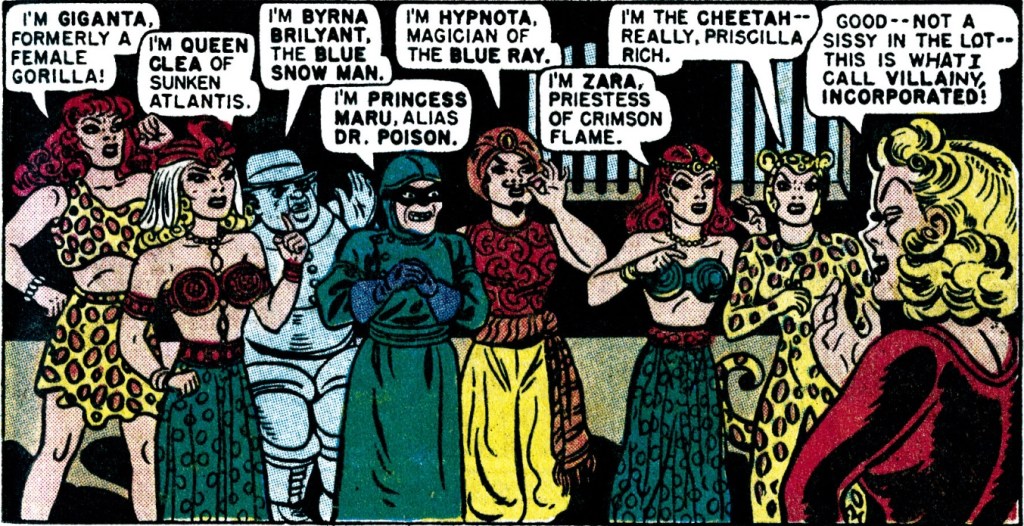
Then again, we know there’s a retconned arch-foe of Alan’s coming, the Red Lantern, seen in a Who’s Who entry in the recent New Golden Age special, who gets his power from the Crimson Flame. So it looks like poor Alan is to be involved in a second accident, before the final page of this issue, which seems to be conflating Alan with a very, very minor character from All-American Comics #16.
Whatever Sheridan is doing – and it may not be his idea, James Tynion IV wrote the first gay Alan story a few years back, and Red Lantern is Geoff Johns business – it’s definitely confusing. It’s enough for me to take in that Alan wasn’t the straight gay he always presented as without adding layers to the origin in a story running up and down his timeline. Just give me a new Alan Scott tale – or Alan Ladd-Scott as he styles himself here, which is far too on the nose for my liking – set in the past or today, using the new background (it’s not like the hideous beard he’s suddenly sporting in the 21st century isn’t in need of explaining).
And on the subject of Alan’s hair, how very dare they!

And why the business with Hoover and the JSA? Why sully Alan’s JSA career with the implication he was there, if not as a government spy, at least under duress. Hoover blackmails Alan with the photos taken in this scene, pictures taken by an Alan Scott who is consistently shown as terrified of being found to be in a gay relationship. Taking the photos is the very opposite of sense.
That reference by Hoover to combat boots seems a tad kinky, and towards the end of the instalment it comes up again, and I have no idea if I’ve missed something. Anyone?
The book opens with a newspaper article telling of the Green Lantern’s latest run-in with Solomon Grundy, using a panel from his All-American Comics #61 debut. What’s great about it is that Sheridan uses the blousy prose style I imagine newspapers of the period had… and it’s written by Scoop Scanlon, who had his own strip in Action Comics.
Points, also, for the diary-style expositional narration by Alan, which is nicely written.
Often a comic book opens with a fantastically well rendered cover, then less impressive art on the interiors. Not here. David Talaski’s eye-catching image homages Alan’s first hero shot from his Forties debut.

It’s gorgeous, but so is the interior art by Tormey and Herms. From Alan’s office to the police uniforms, the vintage atmosphere convinces like nothing we’ve seen since the heyday of All-Star Squadron. The characters look fantastic, especially leading men Alan and Johnny, and the storytelling is terrific – the point at which I get confused is down to the script, not the interpretation of it. I assume it’s Herms who is laying down the Benday-style effect, though it may be Tormey. Either way, it’s evocative of the Golden Age (OK, both the Thirties and Forties were Golden Age, but it’s a useful way to quickly signal where we’re at). And the flame effects, both green and crimson, are tip-top.
Letterer Lucas Gattoni has more script to deal with than most of his peers but does a splendid job of making the words looks elegant on the page.
I enjoyed this issue an awful lot. I had questions, but I like to have questions. A comic that leaves you thinking means extra value – so long as things are cleared during the run, we’re gold. I admit I do have problems accepting this as the same Green Lantern I’ve been reading about since I was a kid, so I’m setting the idea aside. This is the Alan Scott of another world and his story is different to the one I know. I’m happy to fly by his side as the emerald light illuminates his journey.

 Too Dangerous For a Girl 2
Three years before this story, in the real world in 1933, Adolf Hitler’s Nazi Germany began a nationwide crackdown on gay men including sending some to early concentration camps by 1936 (the timeframe of this story), including beginning in the Sachsenhausen concentration camp. According to the USHMM, a year earlier, in 1935, Hitler led a “systematic persecution of gay men and men accused of homosexuality.” There is no question about the legal abuses and problems in the USA and the criminal abuses by J. Edgar Hoover. But the fascism that the JSA battled included rounding up gay men into camps and even murdering them. This is not a trivial “aside.” The battle of the JSA against fascism is an important part of the Green Lantern Alan Scott and of the JSA’s identity. The JSA was created to help sell more of the individual comics in All-Star Comics issues to be certain, but then there was the appreciation of a greater goal and more noble cause to inspire and lead on values on equality, dignity, and to provide a challenge to fascism and hate. It is very sad to see the JSA dismissed like this in the first issue, and it omits so much very important and real historical context of the times and of the JSA. It is not a zero-sum equation of being gay and respecting this history and social conscience. We can and should have a leading gay heroes and heroines, and we can also respect the actual history and truth of the times. So I find this issue very disappointing.
LikeLiked by 1 person
Thanks for the thoughtful comments, Jeffrey. I’m not clear on what Hoover is thinking as regards the JLA – I’ve always seen the Society as a team of equals so don’t understand why he feels Alan needs to be front and centre. The idea that Alan wouldn’t want to be fighting alongside Jay, the Spectre and co is weird. It feels like Sheridan hasn’t thought through the big picture the way you has and is just using them as a maguffin to get Alan to a particular page. Does he have a cunning plan that will make sense of things? Or is this just Hoover’s skewed perspective, that the JSA needs a flagship star and he thinks Alan should be it. Alan is certainly reluctant to act with the JSA here in a way that’s clearly wrong for the character, but that doesn’t mean the team isn’t an effective fighting force and that Alan won’t quickly see he’s wrong, and that society is especially important for a man feeling alone. 1941 is at the start of the JSA’s history so this issue could be a tiny piece of retroactive continuity and we’ll get on track soon. Fingers crossed.
LikeLike
Alan Scott tended to go off on his own when the JSA broke off into groups in the old All-Star Comics. I wonder if that was part of the inspiration for the “I work better alone” attitude.
LikeLiked by 1 person
Aha, thanks, I’ve not read enough of the old stories to have noticed the pattern… time to dig into the couple of Archives I have!
LikeLike
This is a wonderful story with great art. It’s just not I want for Alan Scott. Bi I could accept. It wouldn’t mean ‘everything you know is a lie’ would come into play.
This nonlinear though didn’t throw me but I like it better than you did. There were always enough context and visual clues for me.
With Red Lantern on the board, I’d go with a whole Lantern Spectrum. Seven people with similar but not identical rings with different origins would be way better than entire corps and problematic bits Johns Used. (I’m talking about fear always being evil characters like no one ever heard of the fear of God and Predator being the avatar of a corps dedicated to love chiefly but there’s tons more)
LikeLiked by 1 person
Oh Lordy no, I’m done with colour corps, and elementals and the like, these things can so easily get out of hand.
LikeLike
Seven people would be more manageable than thousands and there wouldn’t need to be emotions (like willpower *snicker*) associated. Just six others with Alan’s ‘ability’ but with different driving forces.
LikeLike