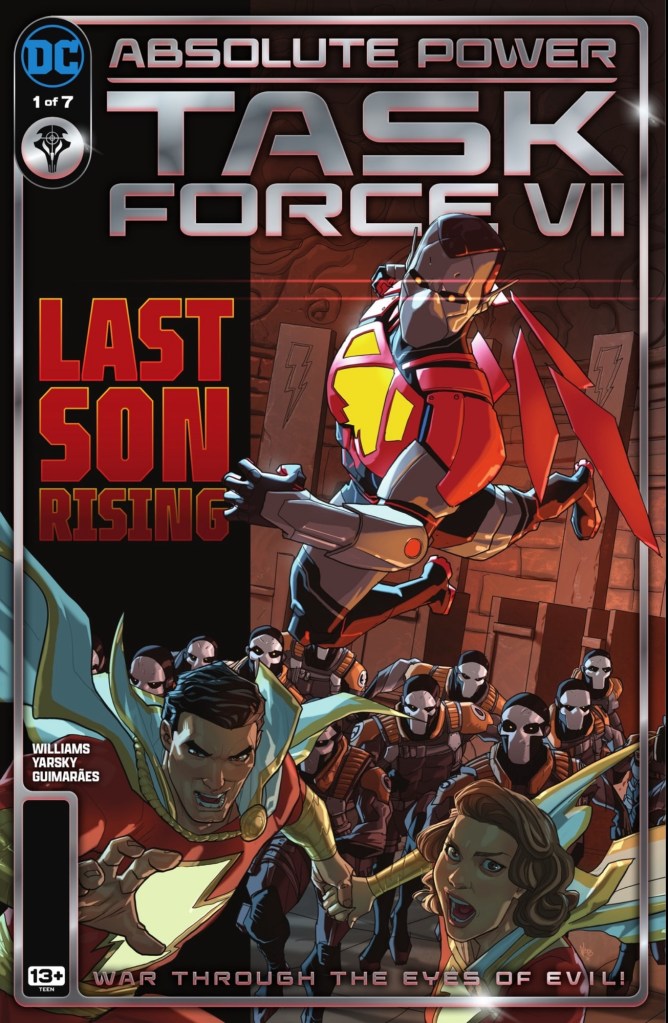
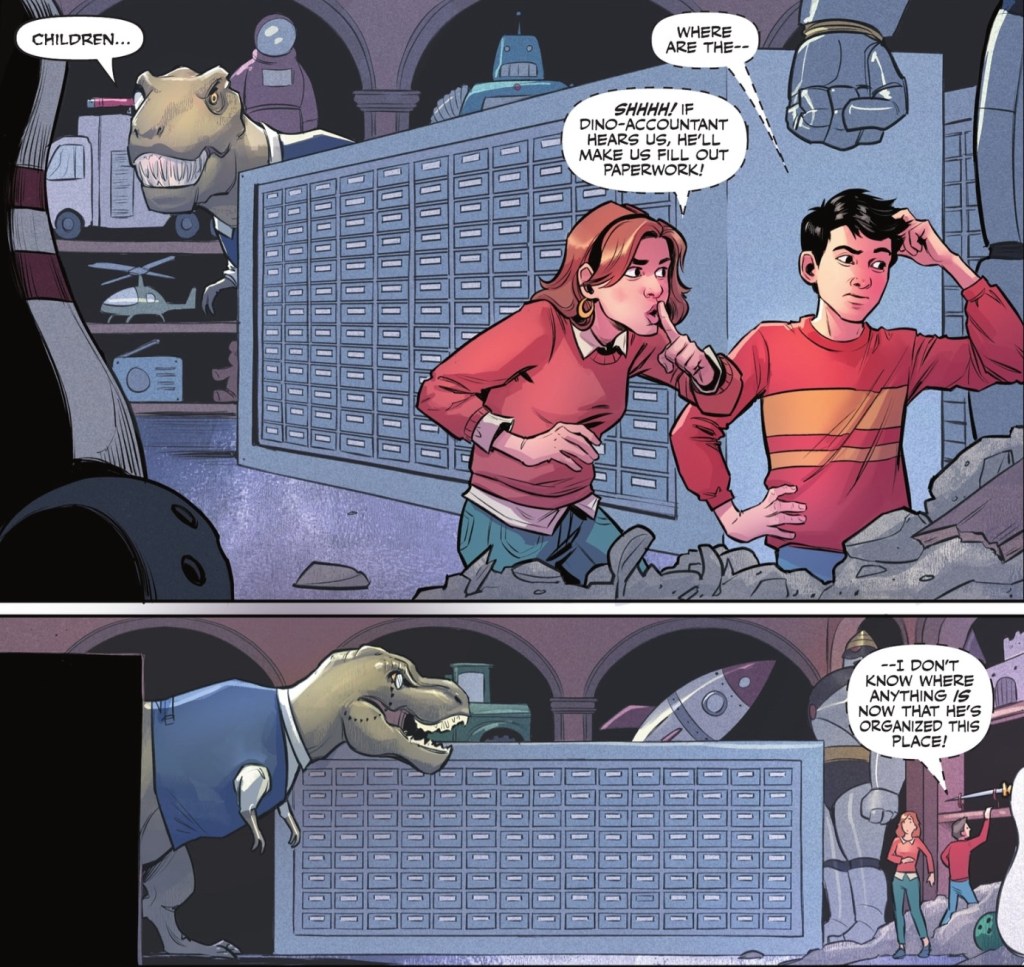
The modified Amazo androids gifted Amanda Waller by the Brainiac Queen and Failsafe have captured the majority of Earth’s heroes. Among the good guys on the run are Billy Batson and Mary Bromfield, most of their Shazam powers having been drained. They’ve taken refuge at the Rock of Eternity, the extradimensional hideaway connected to their Philadelphia home. Surely there’s something among Captain and Mary Marvel’s souvenirs that can help?
‘The Wall’, meanwhile, has a plan to track the kids down.

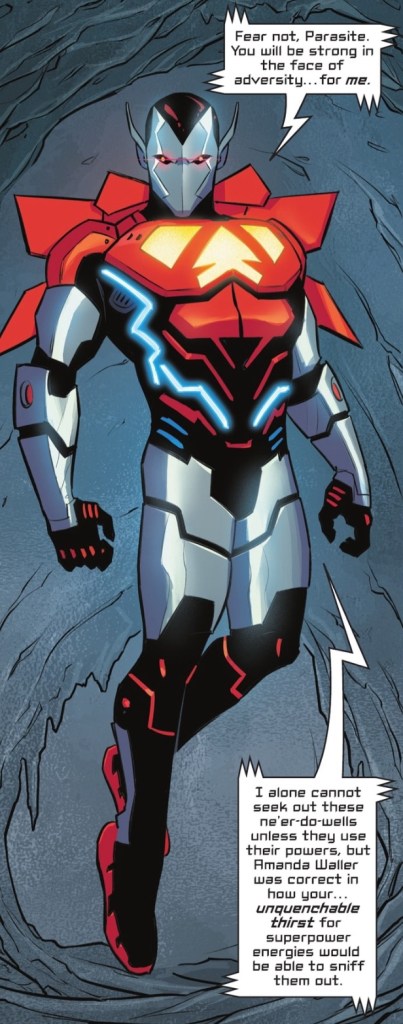
She knows the young heroes will be at the Rock, but wants Parasite to lead the Amazo known as Last Son – it stole lots of Super Family energy – directly to them.
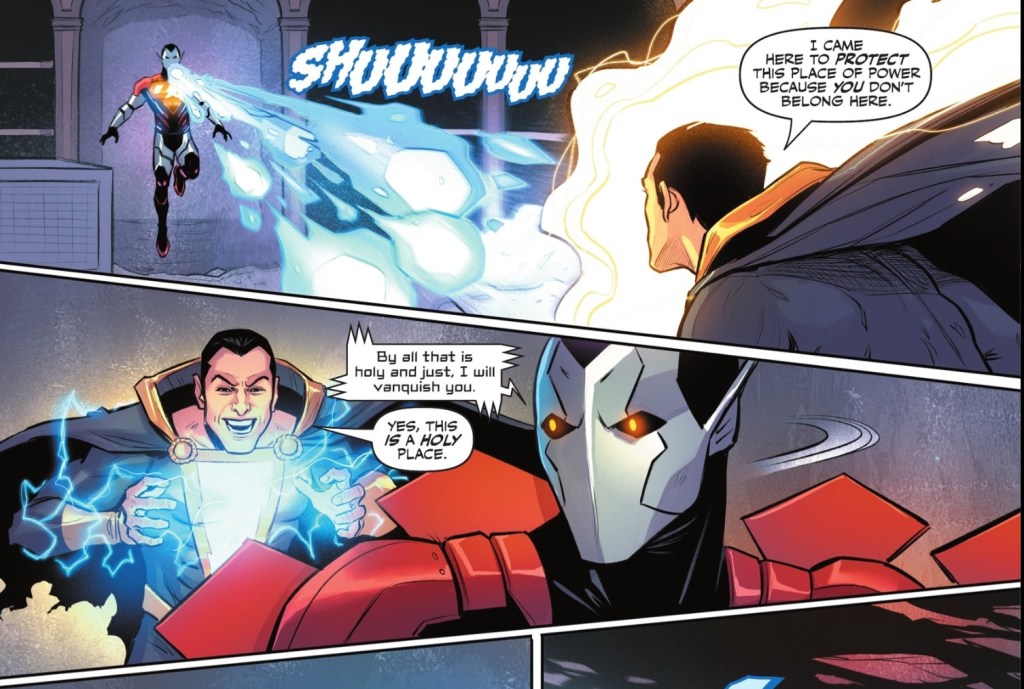
What she hasn’t anticipated is the arrival of another protege of the old wizard Shazam.
Later, we see that Wonder Woman’s chap, Steve Trevor, is one of Waller’s US government lackeys.
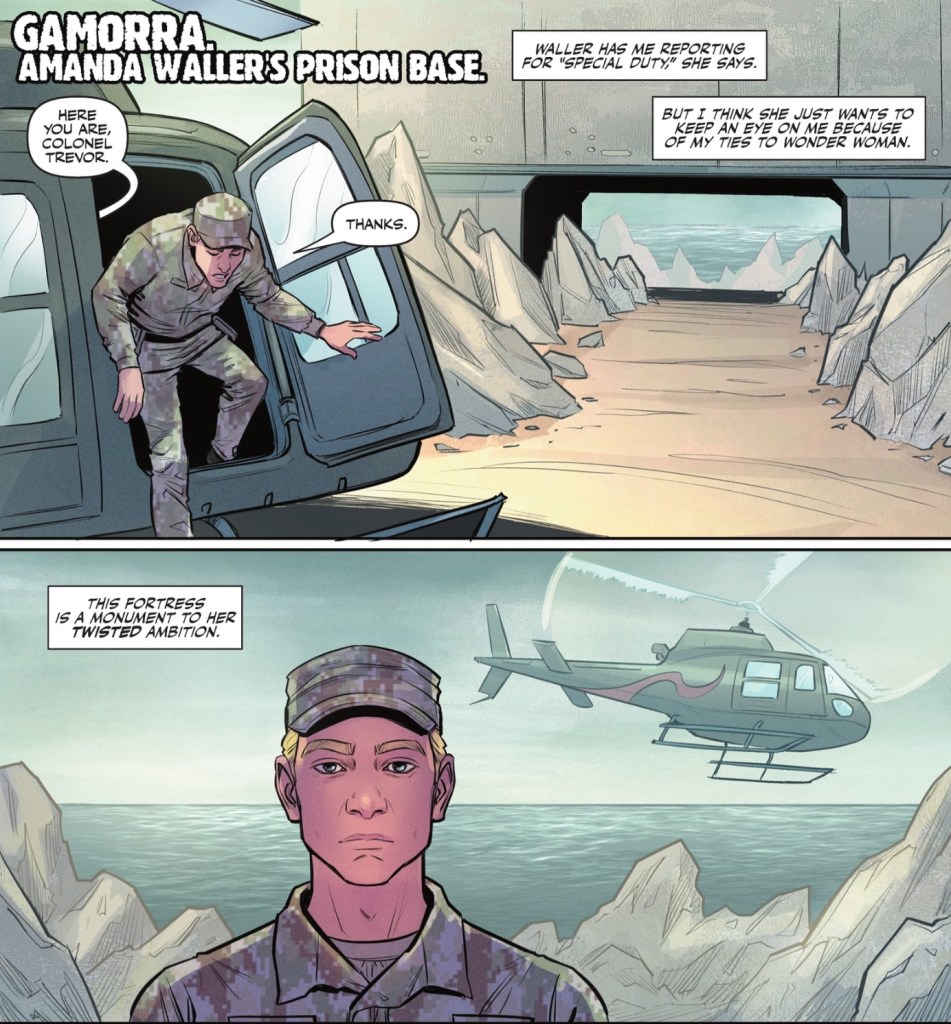
Get in there Steve! Cause some trouble.
I picked this issue up assuming it was one of those DC anthology books they tend to release with events these days, but it’s basically a bonus issue of Shazam! I do follow and enjoy the series, but having seen in the solicitations that an obscure Seventies fella is to play a vital role in Absolute Power, I’d expected bonus books to showcase other DC heroes who could use a little attention. Firestorm, say. The Atom. Monkey King. Sideways. Heck, give me the Power Company and Primal Force.
But it is what it is, and it’s not bad – it’s written by Power Girl writer Leah Williams and it’s fair to say I’ve not connected with that book. Here, though, she stays true to the recent, horrific characterisation of Waller, with poor Parasite, who’s recently been trying to be less monstrous, being treated abominably. So far as this issue is concerned, I’m not convinced Parasite is needed to find Mary and Billy, but it could be that her treatment of the purple people eater will lead to him getting revenge on the ‘Amandazos’ as Absolute Power wraps… heck, who better to beat a squad of power absorbers than a power absorber?
Here’s a moment I really like, as Mary tells it like it is so far as DC’s gods and elders are concerned.
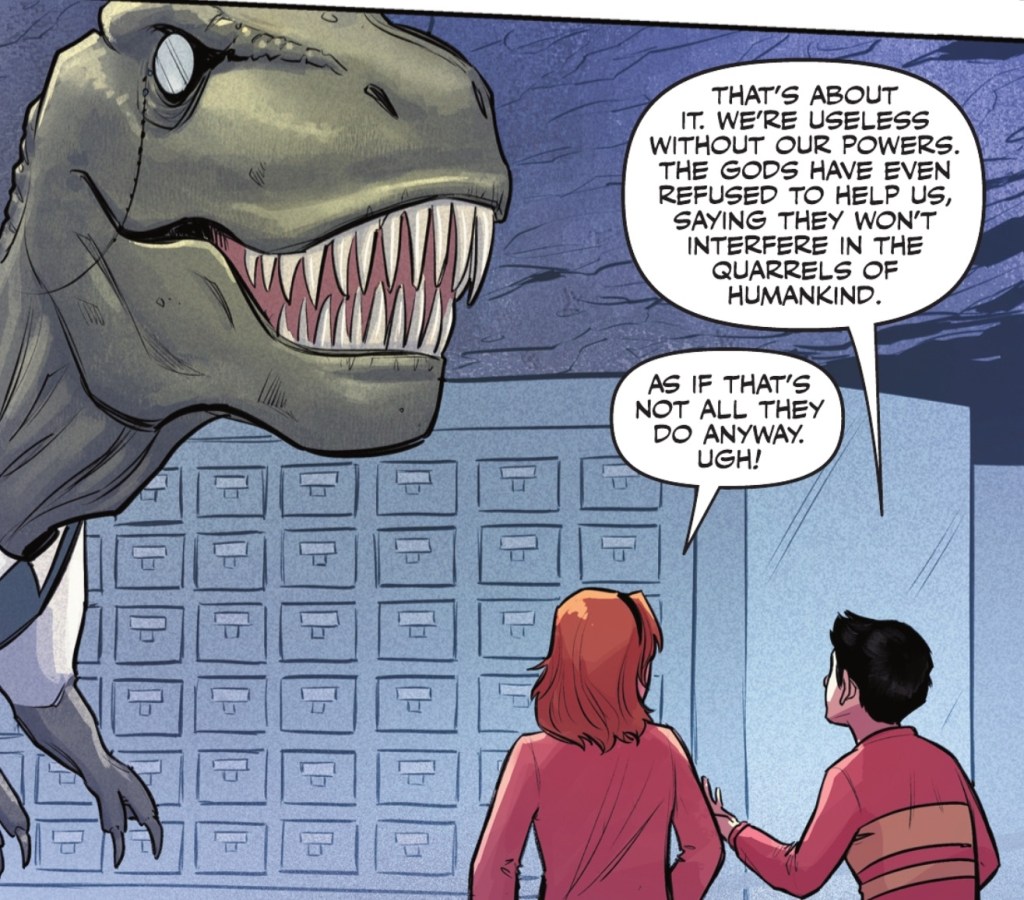
I’m less convinced by Black Adam’s conclusion here… how would that work?
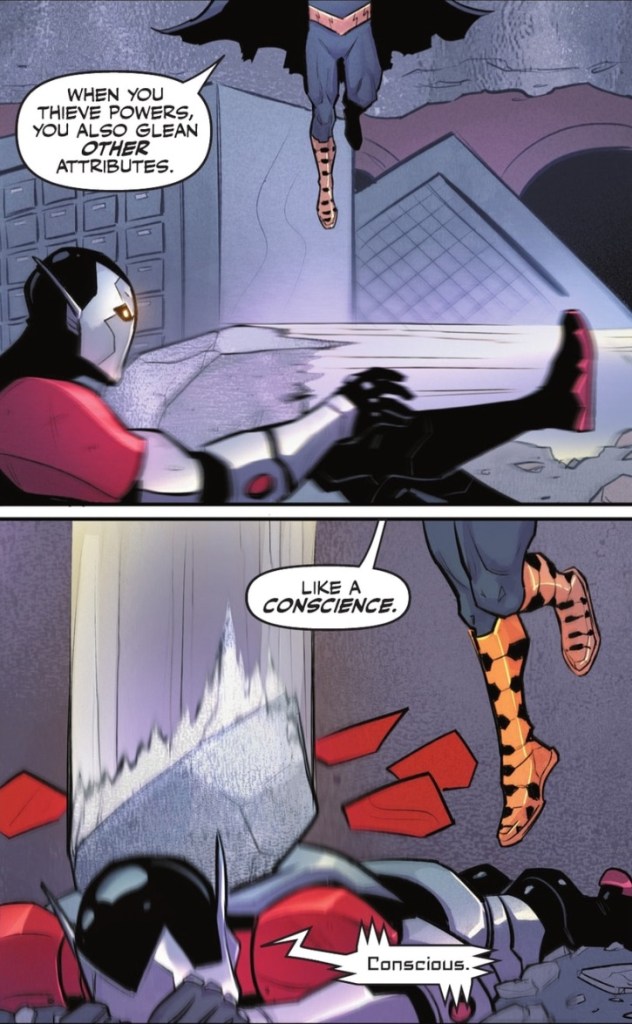
Also, at one point he uses the magic word to blast Amazo with lightning, but it doesn’t change him back to Teth-Adam.
Caitlin Yarsky’s storytelling is good, bringing a pleasing energy to the narrative. There’s a fun outfit for Waller including knee pads – practical as she’ll eventually be on her knees – and Super-Amazo looks rightly intimidating. A small quibble is that Mary and Billy look a tad young – current canon has it that she’s 18, with Billy a couple of years younger… they’re no longer twins. Here they both look about 14. That said, they’re full of character.
Back to the positives, Yarsky gives Black Adam an interesting body language, and totally sells an amusingly villainous giggle. Best of all, though, is the artist’s portrayal of Parasite, cringing and emaciated.
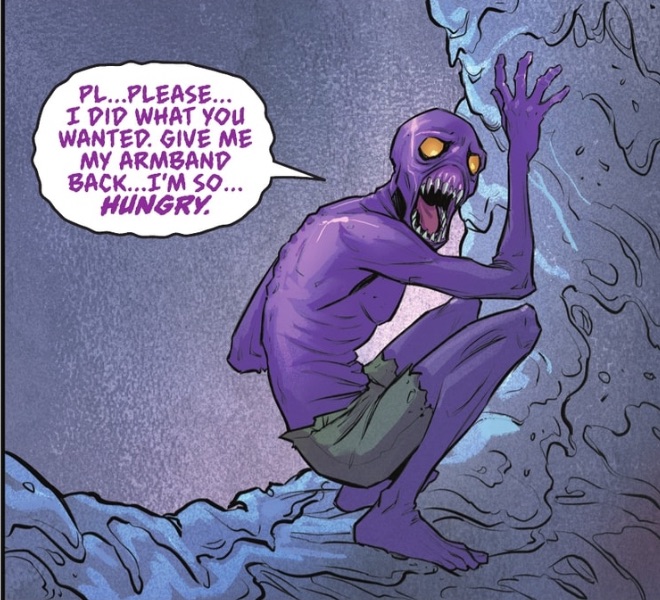
Don’t you want to give him a hug?
Alex Guimarães puts a lot of thought into the colours, the mostly moody tones reflecting the dire situation, making the occasional bright pops of energy all the more welcome. And letterer Dave Sharpe turns in another excellent assignment.
The cover is a tad misleading – Mary and Cap don’t appear at all – but isn’t it dramatic? Where has artist Pete Woods been lately?
I can’t quite work out the schedule of this comic – the next issue is out in a fortnight, the third a week later – but based on this first issue I’ll be keeping an eye on it. If the Amazos don’t get me first.

 Too Dangerous For a Girl 2
Nice review. One positive thing about this issue is that it along with this week’s Green Lantern resolved a lot of issues from Absolute Power #1. We learned in the epilogue with Steve Trevor what the rest of the world thinks about this: they’re pissed at the way Waller used her robot army to violate their borders and enforce American policy, so they didn’t just accept her wantonly compromising their sovereignty. The financial markets are also deeply rattled by the chaos Waller has unleashed, so society has not simply accepted what she’s said and carried on with business as usual. At the same time, the villains of the DCU haven’t taken advantage of the heroes’ absence to go nuts because Waller apparently has some as yet unspecified contingency for them. Finally, Green Lantern makes it clear that Waller fully expects Thaaros and the UP to eventually backstab her, but apparently believes that the plans she has to counter that will be sufficient to prevent any plans of theirs from succeeding.
None of this is to say that Waller’s schemes are actually going to pan out. Although she has enjoyed staggering short term success, there’s still every possibility that her contingencies will fail and/or that she’ll be overwhelmed by some threat she hasn’t anticipated. Absolute Power #1, this, and the various tie ins to Absolute Power have made it clear that Waller is much more arrogant and unhinged than normal. She’s almost certainly vastly overestimated her competency, while greatly underestimating her foes because of this. Her obsessiveness and narrowmindedness regarding superpowers also mean it’s very likely that she hasn’t prepared for a number of threats that may be lurking such as her robots turning on her or some threat from the multiverse crashing in.
More mundane ramifications of her actions may also be part of her downfall. The alienation of other countries and the damage to financial as well as the wider economy may ultimately spur America’s political and business elite to turn against her if it looks like her behavior will compromise America’s geopolitical and commercial standing by making the country into a pariah state. Alternately, Waller’s alienation of the rest of the world might become so extreme that she pushes the planet towards World War 3, at which point the remaining heroes and elements of the military and civilian government who don’t want that may have to band together to stop her. The villains she thinks she’s handled may be far more formidable than she thinks, as might Thaaros and the UP. Whether or not any of these particular events happen, it’s clear that Absolute Power is virtually guaranteed to end with her downfall and the heroes broadly restored, so characterizing her as an overventuresome, megalomaniacal super bigot is functionally a way of explaining why she’ll eventually fail.
The real question then is why Waller is like this given that this level of hatred of super powered people and recklessness isn’t in line with most of her prior characterizations. The answer to that probably rests on two points. The best way to view the Ostrander/Yale Waller is that she’s Waller relatively early in her career, whereas this Waller is a significantly older woman who’s been psychologically warped by years of working with the worst people and disasters in the world, without the cycle of deceit, violence, and chaos ever seeming to stop. A parallel example of this in fiction is John Le Carre’s depiction of George Smiley, who after decades of working for MI-6 is a depressed, worn out man who seems to view his job as nearly futile and meaningless. This is something that apparently happens to many people in the real world who work in intelligence and black ops, and something like it has likely happened to Waller. The difference is that whereas the response of most real world people to this phenomenon is to follow Smiley’s response of a sort of grim resignation of their inefficacy, Waller’s reaction is to snap and lean into a wild, hate driven gamble in the hopes that she can smash the whole system once and for all.
The second reason Waller is behaving like this probably has something to do with her time on Earth 3. We still don’t know a lot about what happened to her there between when we last saw her there and when she returned to Earth, but I suspect it was something very bad. She mentioned in Green Arrow #9 that her experiences there had convinced her that super powered people are too dangerous to be left alone, which is a conclusion somebody could pretty easily reach if they were stuck for a prolonged period of time on a world like Earth 3 that’s been turned into a dystopia by super powered people. Particularly if we assume that Waller already went to Earth 3 heavily jaded and psychologically burdened from decades of black ops work, it’s possible that she experienced some trauma there which finally caused her to snap and become the out of control, power mad egotist seen in this event.
The ultimate point here is that while I get your issues with her portrayal here, I don’t mind this characterization of Waller because I don’t think it overrides earlier, more reasonable ones and because I think there’s a solid potential explanation for it. In many ways, the most interesting part of this event is going to be the origins title for her that’s apparently going to explain why she’s doing this. If it succeeds, I think it will make the event a lot more coherent and compelling; if it’s botched and Waller’s motives end up being nonsensical though, then the event will probably end up being a failure.
The final note I have on this is that I was struck by how decent Leah Williams was here. After the debacle that’s been the ongoing Power Girl series, I had written her off as a hack. She still doesn’t seem to be a genuinely good writer, but she did a decent job here with Billy, Mary, and Dinosaur Accountant. That’s interesting, because it probably provides some insight into what she should be doing instead of Power Girl. Right off the bat, it probably helps that the current Shazam! series provided her with a lot of background detail and characterization. Williams said she knew nothing about Power Girl when she started writing her and was given very little direction on what to do with the character’s background, associates, and persona, so being given a great deal of background and characterization probably helped here. There’s also a fairly decent chance that because she had to move Billy and Mary to a defined endpoint to make the story fit into Waid’s overall narrative scheme for absolute power that she was significantly hemmed in by DC’s editorial side from indulging in a lot of the more bizarre or pointless creative choices she’s made as a writer on Power Girl. Editorial control may have also helped her maintain a decent portrayal of Billy and Mary if the editors forced her to stick to a reasonable characterization of them so as to not Shazam! readers who decided to follow Absolute Power.
One other quality of the story is that Williams style and creative inclinations seem far better suited to the corner of the DCU that Billy, Mary, and the rest of the Shazam! cast inhabit, which is to say the fantasy and paranormal side of the DCU. It’s telling that every story in Power Girl so far has involved elements of either fantasy and magic (e.g. Ferimbia, the whimsical creations of the animation gun in the latest arc such as the dragon motorcycle, or the fantasy turn which the next arc is apparently aiming for) or paranormal phenomenon (the psychic counseling service in Action Comics and the Special, her psychic posession by Symbio, everything to do with Omen). This is what seems to interest Williams far more than the more conventional “present day” super heroics or sci-fi milieu that the Kryptonian contingent of the DCU tends to be best suited for. The whole root of the Shazam! chunk of the DCU in magic and fantasy makes it a much more natural fit for her than the Kryptonians, and by extension the kid oriented nature of that part of the universe also plays into her apparent predilection for YA type stories that she’s leaned towards with Power Girl.
None of this is to say that she should be given Shazam! after this, nor does it redeem her work on Power Girl. What can be gleaned from all this is that Williams never should have been given Power Girl, and should have instead been put on a more youth oriented title with a well defined character and world that played into her interests such as Amethyst or Raven. I’m on the fence as to whether she belongs at DC at all since this book is still just ok and I’m not convinced she can write consistently good material – which should be the acid test of whether DC keeps a writer for the long haul – but I am less adverse to potentially reading more from her after this (with the exception that I never want to see her write for Power Girl or any of the other Kryptonians ever again).
Thanks again for the review. I’ll be interested to see if you continue following this miniseries through to its conclusion.
LikeLiked by 1 person
Thanks for the insightful and thoughtful comments. You make the best case I’ve heard for this being a reasonable presentation of Amanda Waller. If what you posit, or something very similar, is put into Absolute Power stories, excellent; OK, it would have been so much better had we seen such things on-panel contemporaneously, but if flashbacks are all we’re going to get, well, that’s something. I do find it amazing that the DC writers and editors didn’t seem to consider that we needed to see the workings out that added up to Absolute Waller – did they think the shock value of this new fanatical version would be enough?
Thanks for the Green Lantern recap… I did do notes for a review last week but didn’t get to it – I apologise, work is just wearing me out at the minute. Roll on the end of UK holiday season. I found the Steve Trevor scene most heartening, but would rather the back-up pages had been used for a longer lead strip – I was really curious as to what was happening to Carol, who was featured on the cover. Meanwhile the UP boss had an ‘origin’ – the story was well done but all it amounted was that Thaaros learned to be a terrible person from a terrible person. Mainly, it had me wondering why his family used the Durlans’ offworld form while at home. I guess I’m just an incorrigible old Legion fan.
So there is hope for Leah Williams at DC… but it seems to be as a scripter, I can’t believe the Shazam story wasn’t heavily co-plotted – or even had the story points laid down – by Mark Waid. Still, it was nice to see her involved with a decent tale. I am, though, dreading Mariko Tamaki writing a regular Supergirl strip after the awful Supergirl Special and the very dull, drawn-out Being Super. If Williams really wants to be writing YA fantasy, I think we can say Tamaki wants to be doing Track and Field Manga.
LikeLike