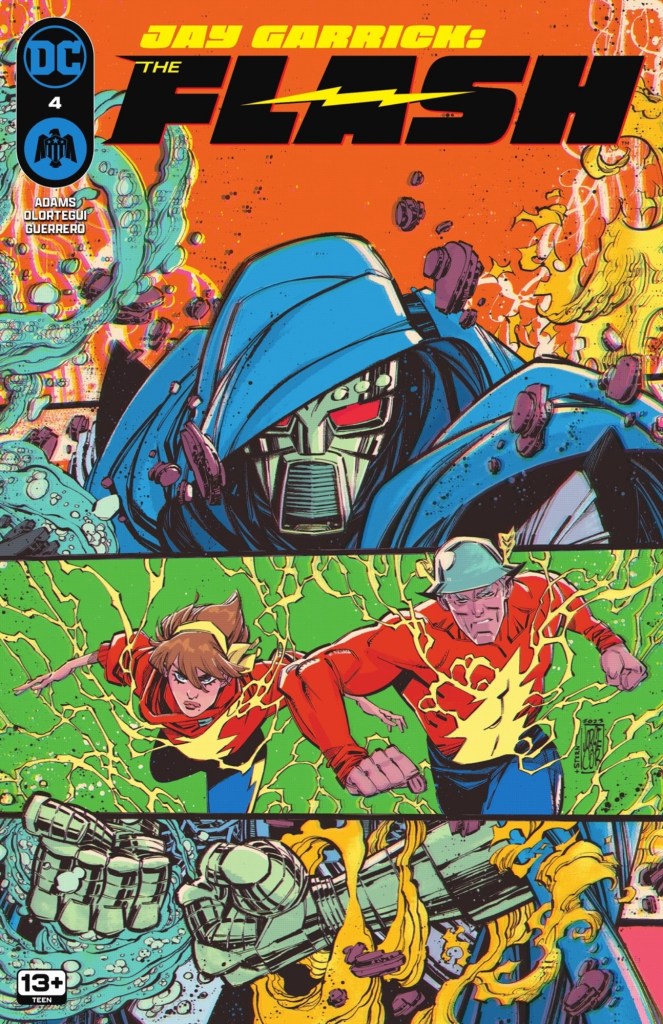
STAR Labs has been a part of DC Comics lore for a long time. I remember its introduction way back in the Seventies’ Superman #246 as a Metropolis scientific research facility. Over the years we learned there were branches all over the globe, and while it’s usually been a friendly place, occasionally dark science has been to the fore. And in the latest issue of this fast-moving mini-series we finally learn the secret origin of STAR Labs, and find that darkness is baked in.
Oh, we also learn the secret origin of Judy Garrick. And the not so much secret, but certainly expanded, origin of Jay Garrick.
Before Jay Garrick #4 dropped digitally, I saw the headlines for this issue at a comics news site, hinting that writer Jeremy Adams was rewriting the origin of the Golden Age Flash. Happily, that isn’t the case. This isn’t an ‘Anatomy Lesson’ for Jay, an ‘everything you thought you knew was wrong’. It’s more ‘everything you thought you knew was right, but there was more going on in the background’.
‘The Waiting Game’ begins today, as Jay and daughter Judy follow a trail of breadcrumbs to STAR Laboratories in Detroit, hoping to find Professor Hughes, a mysterious figure from their past. Hughes doesn’t seem to be there but a man named Slate has been expecting a visit from a speedster for quite a while. He hands Jay the diary of Hughes, beginning in 1938. That’s when the ambitious boffin sees something amazing on the new invention of television.

Already obsessed with the idea of creating a superman, the arrival of one inspires Hughes to up his game. Again and again, though, his experiments end in death for his animal test subjects. Time for a new approach. A human subject.
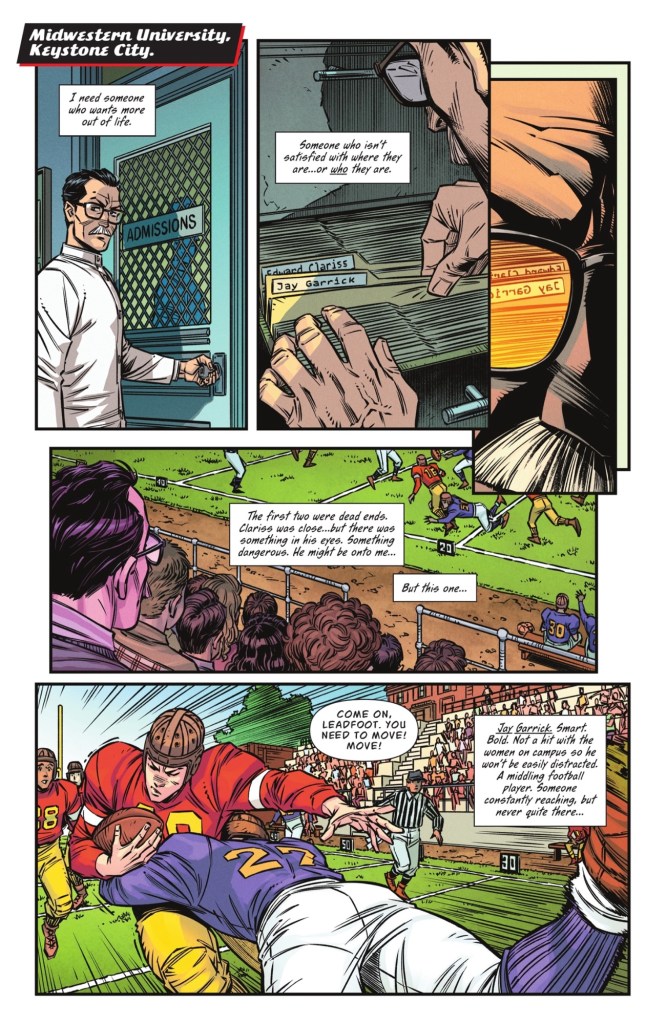
Flattering young Jay, Hughes involves him in his hard water experiments and, after a few years, pulls the trigger on his attempt to create a superhuman.
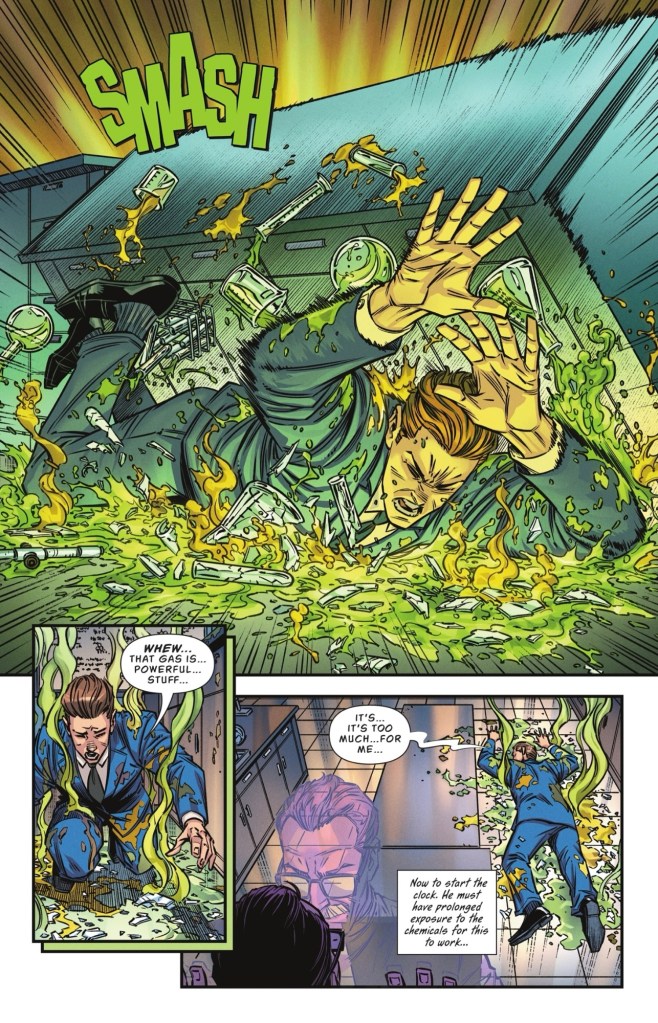
You know the rest. Jay is out for a while, and when he wakes up he has astounding powers, powers that make him a modern-day Mercury. Hughes is assured of this by a hospital doctor who, while recognising Jay’s speed potential, doesn’t recognise he’s dealing with a madman.
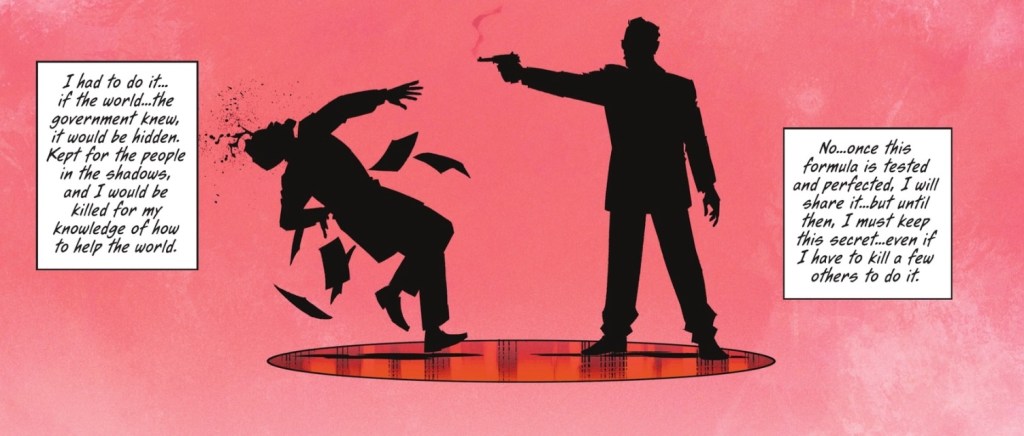
But he means well! Or at least that’s what he tells himself. Any good intentions Hughes had have long since vanished in a vat of mad science. And things only get worse over the following years as, while Jay concentrates on superheroing and wooing the lovely Joan Williams, Hughes fades into the shadows. Every attempt to replicate the experiment results in human corpses. And his obsession attracts the attention of people even more lunatic than himself…
Jeremy Adams delivers another terrific comic book script, building on the work of his forebears to make Jay’s world richer. And the great thing is, if you don’t like writers tinkering with the original stories, with this one you can just ignore the behind-the-scenes stuff. I don’t see Hughes’ manipulation of Jay as taking anything away from the hero – Jay was 18 or something, it’s not too surprising he’s tempted by an older person who’s established in the field that interests him. Jay certainly pulled away from Hughes’ shadow, both as a superhero and a scientist. And while Hughes is also linked to Judy’s speed manifesting, you can take or leave his theories.
Me, I’m very happy with this super-sized origin, which is so faithful to the original it cleverly incorporates young Jay’s filthy smoking habit.
Hughes is an interesting guy, a little Lex Luthor in that he has a lot to offer the world – he realises the existence of the metagene decades before the heroes hear about it – but everything is lost to his ego. As drawn by the excellent Diego Olortegui, though, he’s a taller, hairier Sivana, his cringing cravenness etched on his face, implicit in his body language. Olortegui’s Thirties and Forties scenes are delightful (apart from the ones featuring suffering and death) while the modern moments also benefit from his energetic hand.

Favourite visual moments include that Alan Scott Action Comics #1 homage, and an eye-poppingly fine splash montage of Jay and Hughes’s contrasting careers. And the artist deserves a lot of credit for the sheer detail he puts into panels.
Luis Guerrero’s colours add to the excitement, with the palette for Hughes’ research adventures – purples, greens and magenta – suitably sick inducing. The letters of Steve Wands have a style of their own, and Jorge Corona and Sarah Stern supply another bright and busy cover image.
My only question about this issue concerns Slate, partner of Hughes and public face of STAR Labs.

What’s he been waiting for? If he didn’t know Hughes was a murderous madman initially, he’s known for a long time. Why was he waiting for a Flash to come knocking at his corner office door?
If you’ve seen early issues you’ll know how great this is. If not, believe me, you’re missing out – this is a superb addition to the line of DC superstars.


Slate probably didn’t remember Hughes before Judy and the others were freed. Waiting for some time can be very subjective, especially if he found the journal around the same time Hughes and Judy disappeared from memory. Now he’d be thinking he found it decades ago but his memory would actually be recent. (I credit Star Trek shows for the ability to effortlessly come up with answers to plot holes)
It is a great issue even if the art is still a little too Nauk for me but fortunately story’s king for me. If I like the writer or property you need to be Liefeld on a bad day level to get me to skip a series like this. Adams does such a good job, I didn’t even register until now that Jay and Judy were barely characters in this story. Normally a full issue on this kind of reveal bores me or has me wondering what the real stars of the comic are.
Does this not ending at issue five mean it’s an ongoing? Marvel minis stop at five normally.
and how many times has STAR Labs popped back up after being disbanded now and each time without explanation?
LikeLiked by 1 person
Aha, thanks for explaining the Hughes business, I should have seen that.
I’m pretty sure DC minis are six issues, unless they get cancelled prematurely. An ongoing would be fantastic!
LikeLike