
What a difference an artist makes. Mike Deodato Jr isn’t around this time after handling the first six issues of the latest Flash run. Filling the breach is Ramon Perez, whose art is mostly pretty good, but so far off the established style of the series that it’s jarring.
Where Deodato crowded the pages with dozens of panels, bleeding across frames and right off the page, Perez takes a more traditional approach. And actually, I didn’t mind an issue that dials down the visual intensity.
Last issue ended on quite the cliffhanger, with a classic Flash rogue declaring themselves in the game, so it’s a surprise that we open with Max Mercury and Impulse… somewhere. Last time we saw Bart he was speeding off to find Max, who had been lost as he helped Wally West check out his newfound ability to slide between levels of reality. He’s somehow caught up to the senior speedster, but things aren’t going smoothly.
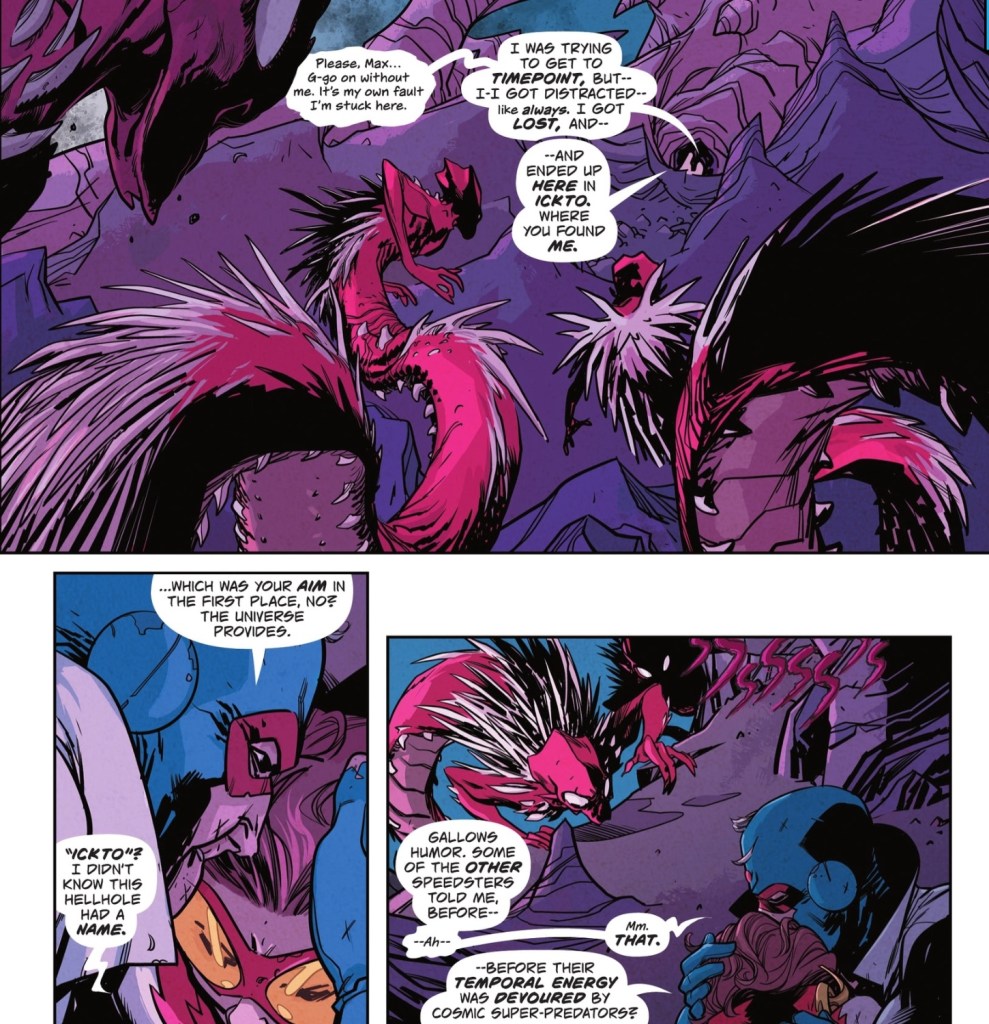
Help is at hand in the form of some strange folk with a name familiar to longtime DCU fans.
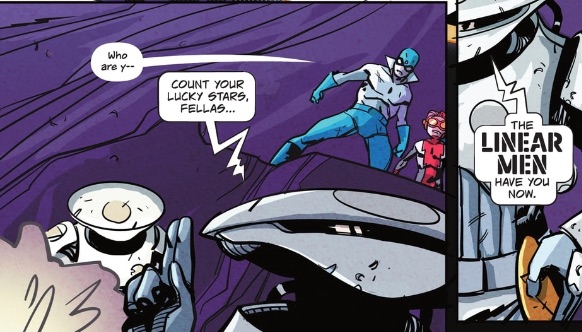
Their boss, Inspector Pilgrim, who previously introduced himself to Wally’s son Jai as a ‘science detective’, takes Bart and Max in a tour of his HQ, which would traditionally be called Vanishing Point.
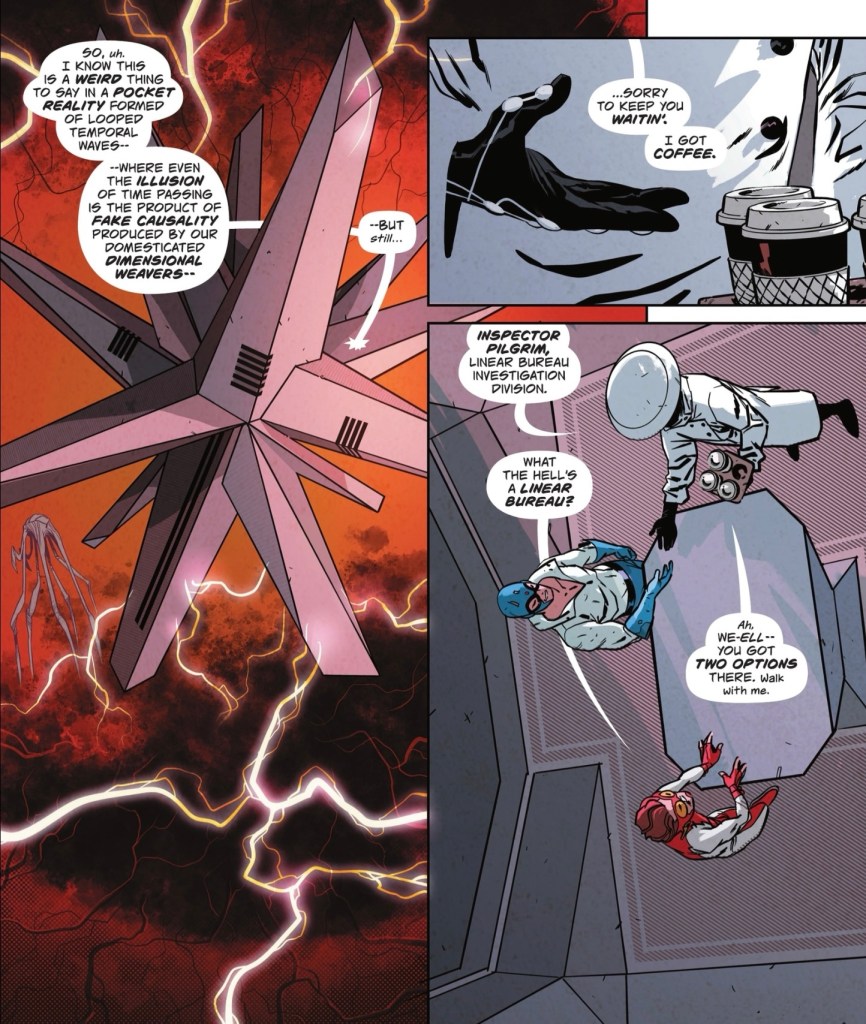
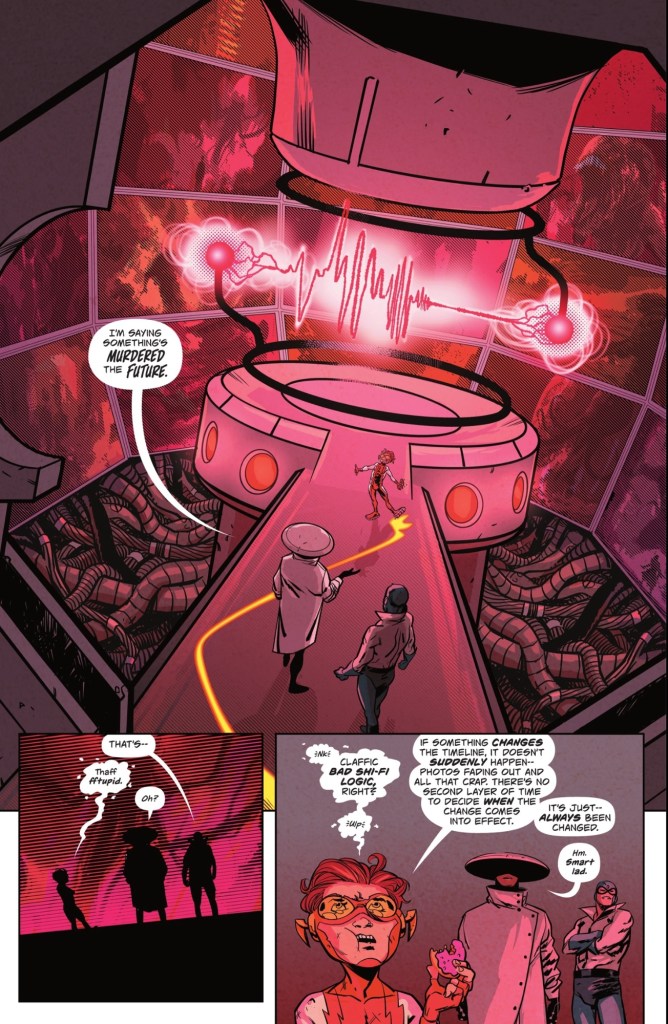
Impulse has a chance to shine as Inspector Pilgrim explains that the Speed Force and reality itself seems to be unravelling due to the existence of speedsters.
Back in regular reality, Barry Allen seems to finally be coming out of the funk he’s been in since the start of this run. But Wally’s wife Linda is sliding further into a weird state of denial that could previously have been mistaken for Busy Mom Fugue.
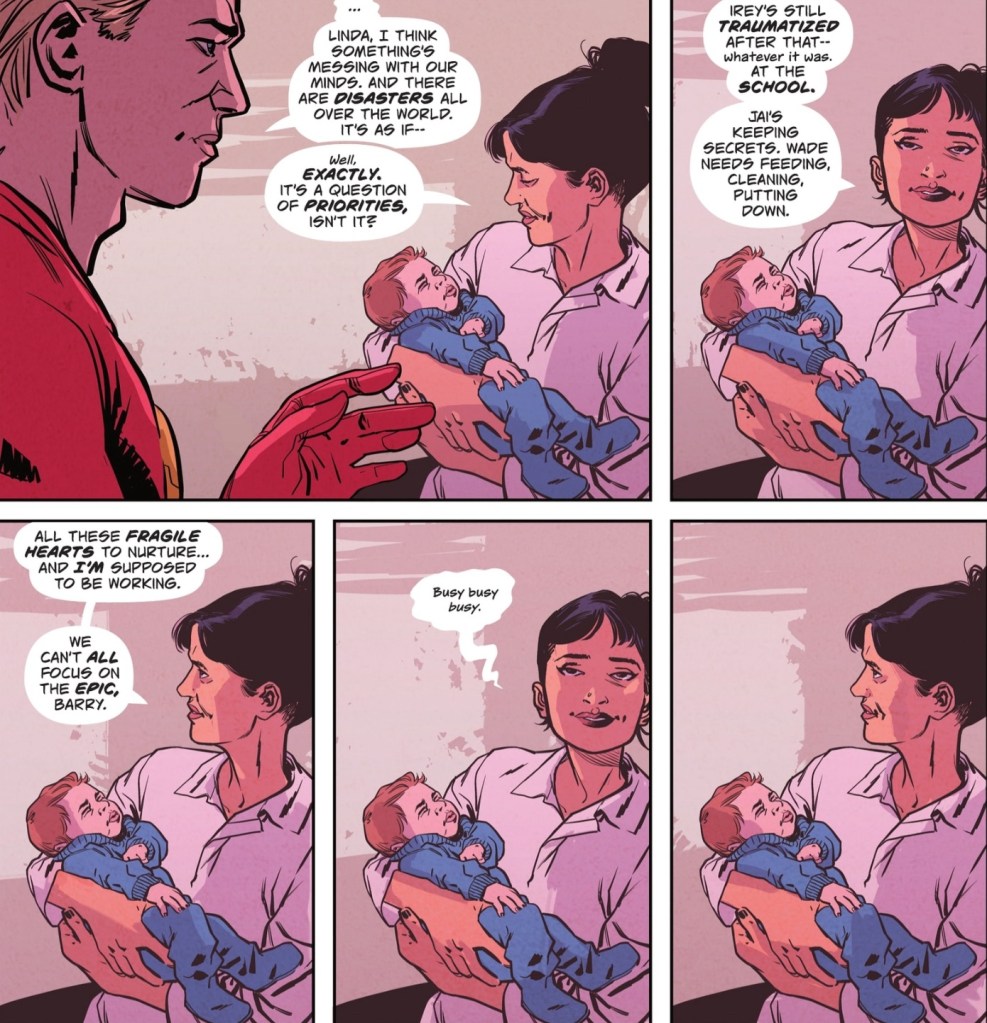
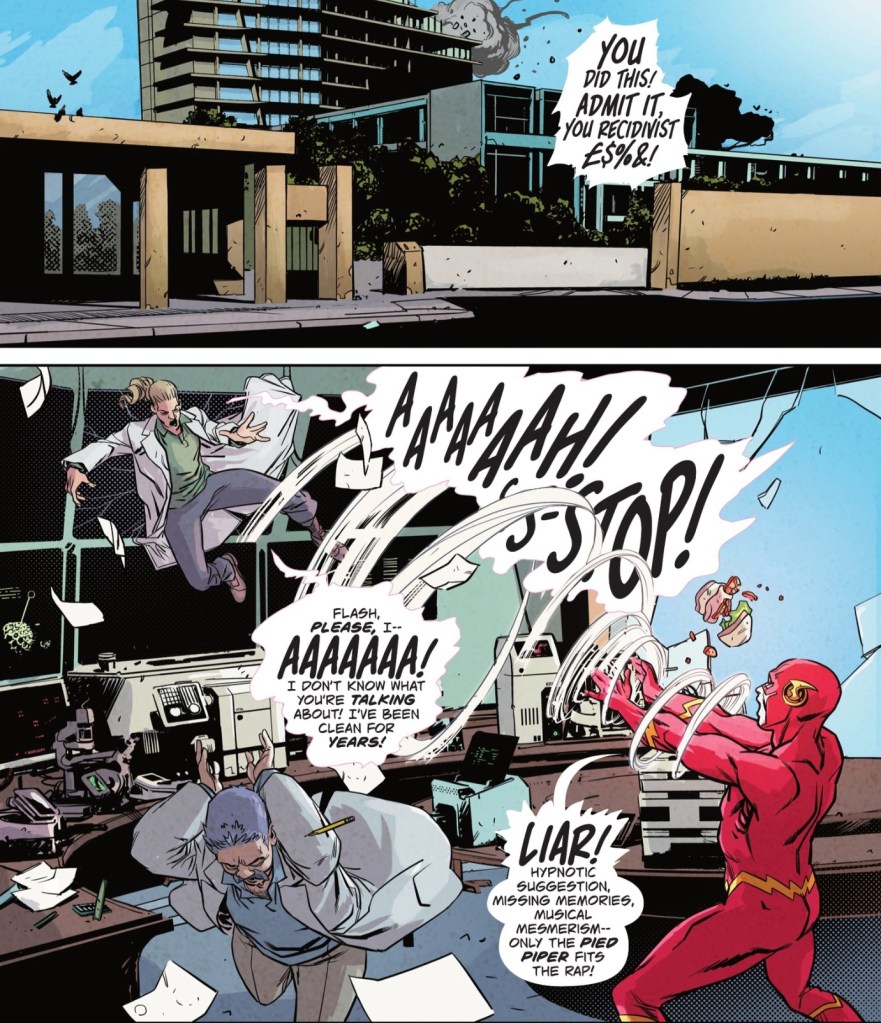
An apparently throwaway comment from Linda about being able to ‘hear the piper’ when Wally isn’t around sends Barry off in search of an old foe.
As for Wally himself…
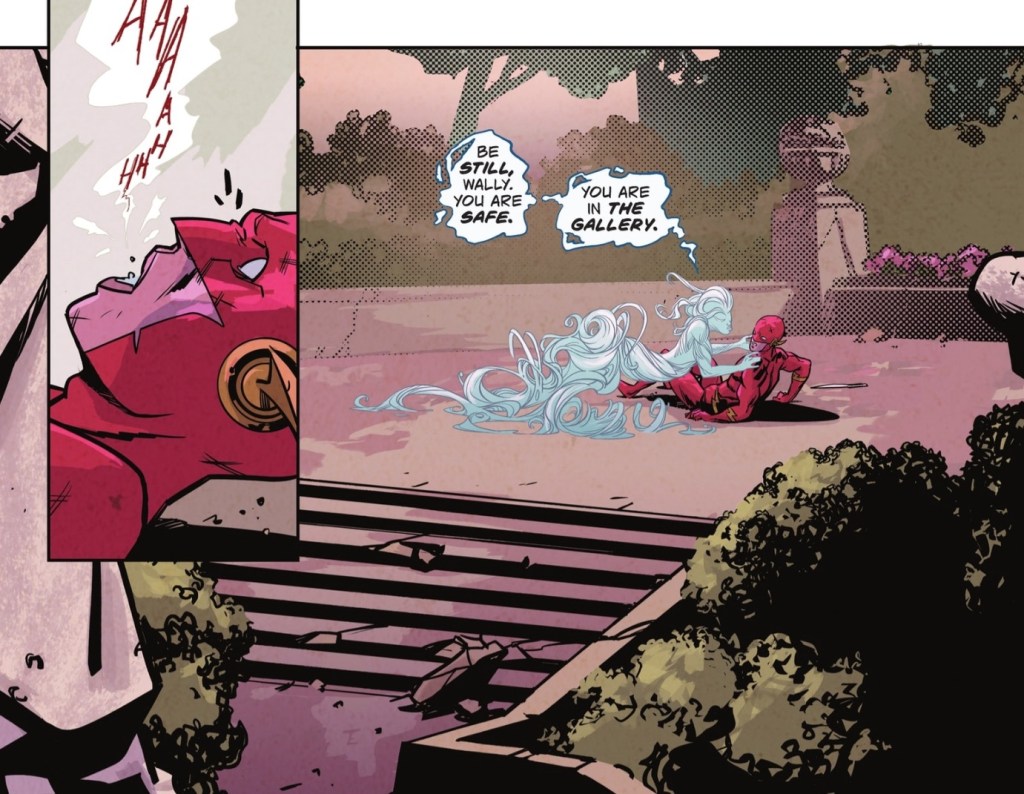
Oh, that ruddy weird garden again.
And the mysteries keep on coming, but there is some forward momentum in terms of finding out what the heck is going on in Spurrier’s serial. And seeing Bart and Max working together took me back to the great days of Impulse’s Nineties series. I was less keen on Barry’s big sweary moment, but at least it’s now been acknowledged on panel that he and Linda really aren’t themselves.
I was glad to see the mysterious Inspector Pilgrim, again, and we may just have here a clue to their identity.
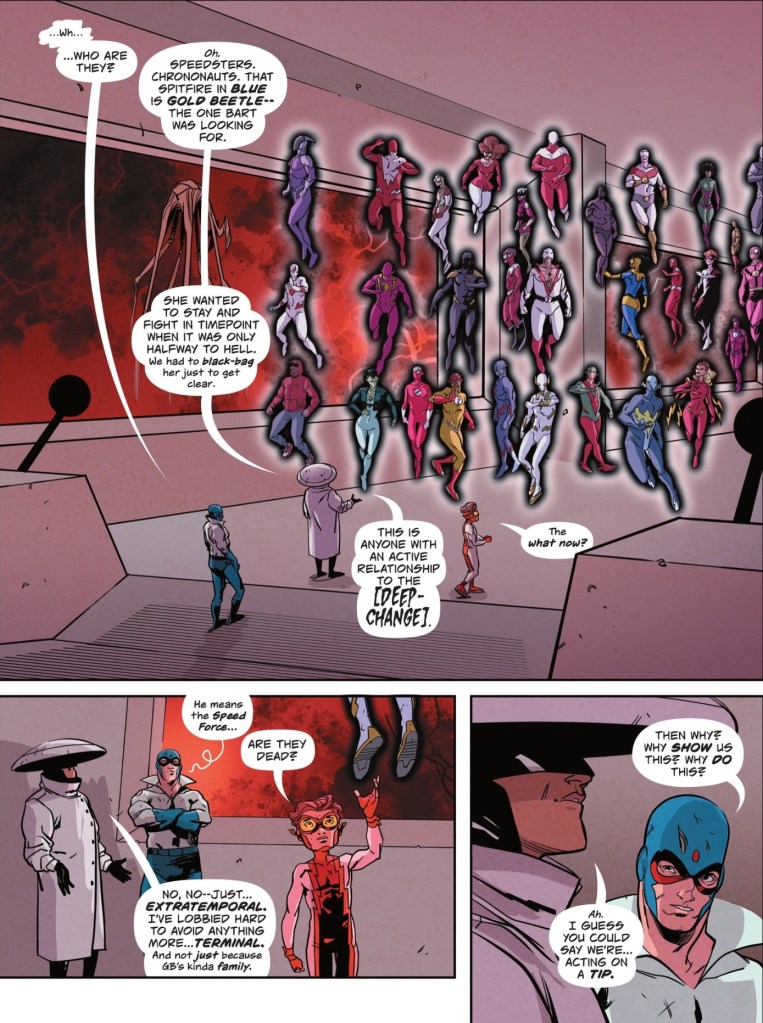
Sadly. We don’t know Gold Beetle’s full name!
Not around this time are the aforementioned Jai, sister Irey, and Jesse Quick, all of whom have been entangled in the big cosmic shenanigans. I think it’s fair to say this storyline is going to be best read as a whole once all the instalments are in – each issue has individual pleasures but it’s very, very tough to keep all the details to mind.
Remember at the start I said the art of Ramon Perez was ‘mostly pretty good’?
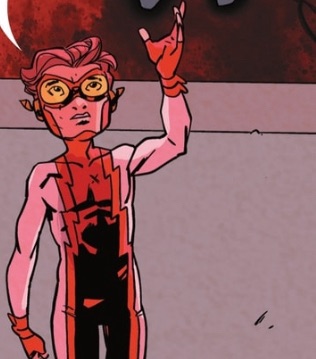
Poor Bart.
The usual double page credits spread is absent this time, but the presence of ‘Dodgson’ on the cover tells us the colourist is Sofie Dodgson, a double Eisner winner in the first DC work I’ve seen from her. She does a great job at keeping the characters distinctive and evoking the eerie atmosphere of the weird locales in which the action occurs.
Presumably the letterer remains Hassan Otsmane-Elhaou, given the distinct fonts and size tweaks, and I appreciate the continuity.
The cover by Perez is attractive, if rather too reminiscent of #4’s opening image.
All in all, I’m still engaged, but really hoping this storyline wraps soon. How about you?

 Too Dangerous For a Girl 2
I wrapped on this after last issue. I don’t think it’s even fun, just … confounding.
Matthew Lloyd
LikeLiked by 2 people
I have to admit, I do miss Jeremy Adams!
LikeLike
I’m having fun with it, but yeah, it’s a little frustrating. I really do love Ramon Perez’s art, though — his Stillwater, with writer Chip Zdarsky, was a terrific thriller from Image a few years ago. And yeah, his Bart is a little wonky — that one panel you highlight particularly– but for the most part I think it works for comic effect.
I’m glad we know Barry and Linda aren’t themselves — I hate to think of my childhood role model lashing out at Piper that way. (Good to see Piper, btw!)
As for the weird tone of this…every few decades, Flash experiences a big, largely temporary, tonal shift. Maybe all comics do, but since Flash is the one I pay the most attention to, it’s the one that sticks out to me. When Ross Andru took over as editor in the 70s, Flash moved into harder crime stories for a bit. Drug smuggling, corrupt cops, Clockwork Orange-like experiments, the death of Iris… it was a far cry from the time-traveling dinosaur story that appeared the issue before.
Likewise, midway through Johns’s run on Wally’s book, there was the 6-part story “Ignition,” with Alberto Dose’s art looking like nothing that had ever been on the book before. Wally had no idea he was the Flash; his relationship with Linda was rocky, and he was a mechanic for the CCPD.
This feels like another swerve like those. They’re temporary changes in tone, although sometimes (as with the death of Iris, or Wally suddenly having mechanical skills) with lasting effects. This tone might last as long as Spurrier remains on the book, but I can’t see it lasting much longer. In the meantime, though, I’m going to enjoy it for what it is, and my surprise at where it takes us.
LikeLiked by 1 person
Thanks for putting things in perspective. I must admit, Barry’s brief Starsky and Hutch period was exciting.
LikeLiked by 1 person
At the time, I was shocked by it! I mean — killing Iris was DRASTIC! And the tone of the book had shifted on my favorite superhero…the stakes were so much higher, and the stories were so much darker. And at the same time, I was RIVETED.
But I think having that experience at such an early age gave me a real “this too shall pass” attitude toward comics as I matured. The Flash’s Starsky & Hutch period — a great name for it! — receded almost immediately when Len Wein took over as editor. Wally West being a selfish jerk ended almost immediately once William Messner-Loebs took over the writing chores from Mike Baron.
Of course, the only way for things to return naturally to the tone & style that historically suits a title is for that title to continually be published. Which is why titles like Supergirl or the Legion have a rougher time than Flash or Green Lantern — if the titles leave the racks, the changes can’t be organic. To return, a new volume of a title has to make a marketing “splash” … which may or may not be enough to sustain it. In which case, you just layer change on top of change, and the original appeal of the concept gets harder and harder to find. But if the publisher keeps with it for a while, the title might eventually find its footing, keeping some of the splashy new stuff but returning to the tone and concepts that first gave it its existing fanbase.
LikeLiked by 1 person
And, I’d add: Those deviations from the norm can be great for the character, even if they don’t seem so at the time. I like that there was a really callow period in Wally’s maturation. I like that his mechanic period in Flash 201-206 has blossomed into his being the nuts-and-bolts guy at Terrifictech. I like how rocky Green Arrow’s relationship with Black Canary has been, and how it’s generally his fault. And I like how, as horrible as Speedy’s relapse into drug use was (and, in particular, how horribly that story in Cry for Justice was told), those moments still inform his character today.
Think about the Hulk, and how much mileage has been gotten from all his incarnations and personalities…which originally started as simply different creators approaching the character differently. If all the stories from beginning to end had the same tone, the DC and Marvel universes wouldn’t have nearly the richness that they do today.
LikeLiked by 1 person
I’m with you all the way down to the Hulk; whole there have been a lot of entertaining periods, it’s just one big mental pile-on after another so far as poor old Bruce Banner is concerned. I just fell so sad for him.
LikeLike
Some brilliant thought, there, Rob. In my ideal world we’d be on issue 300 or something of the (Daring New Adventures of) Supergirl by now. Just think how many terrible relationships Linda could’ve had by now. Maybe the Earth Angel angle could’ve been worked in there somehow.
That Flash run was the first time I saw Cary Bates in non-Julius Schwartz mode and I was severely impressed. It’s a shame Ross Andru didn’t shake up a few more DC books
LikeLike
Yeah, it would have been neat to see what he might have done with Teen Titans (although I’m happy with the shakeup we got!). He actually did edit a run on Wonder Woman around the same time, as well as the Dollar Comics version of Adventure, but most of his editing was on non-superhero books like Jonah Hex and Warlord.
LikeLike
I did enjoy Jonah Hex. If memory serves his time as editor on WW was super short, about a year, but they were good stories -Orana, Animal Man etc.
LikeLike
That sounds about right — and about the same as his time on Flash. He edited issues 270-283, just 14 issues, and then Len Wein took over. But they made an impact! So much of Flash history pivots around them.
I didn’t read Jonah Hex or much of Warlord at the time, but I love rediscovering those issues now!
LikeLike